This Wasn't in the Brochure
Free Chapter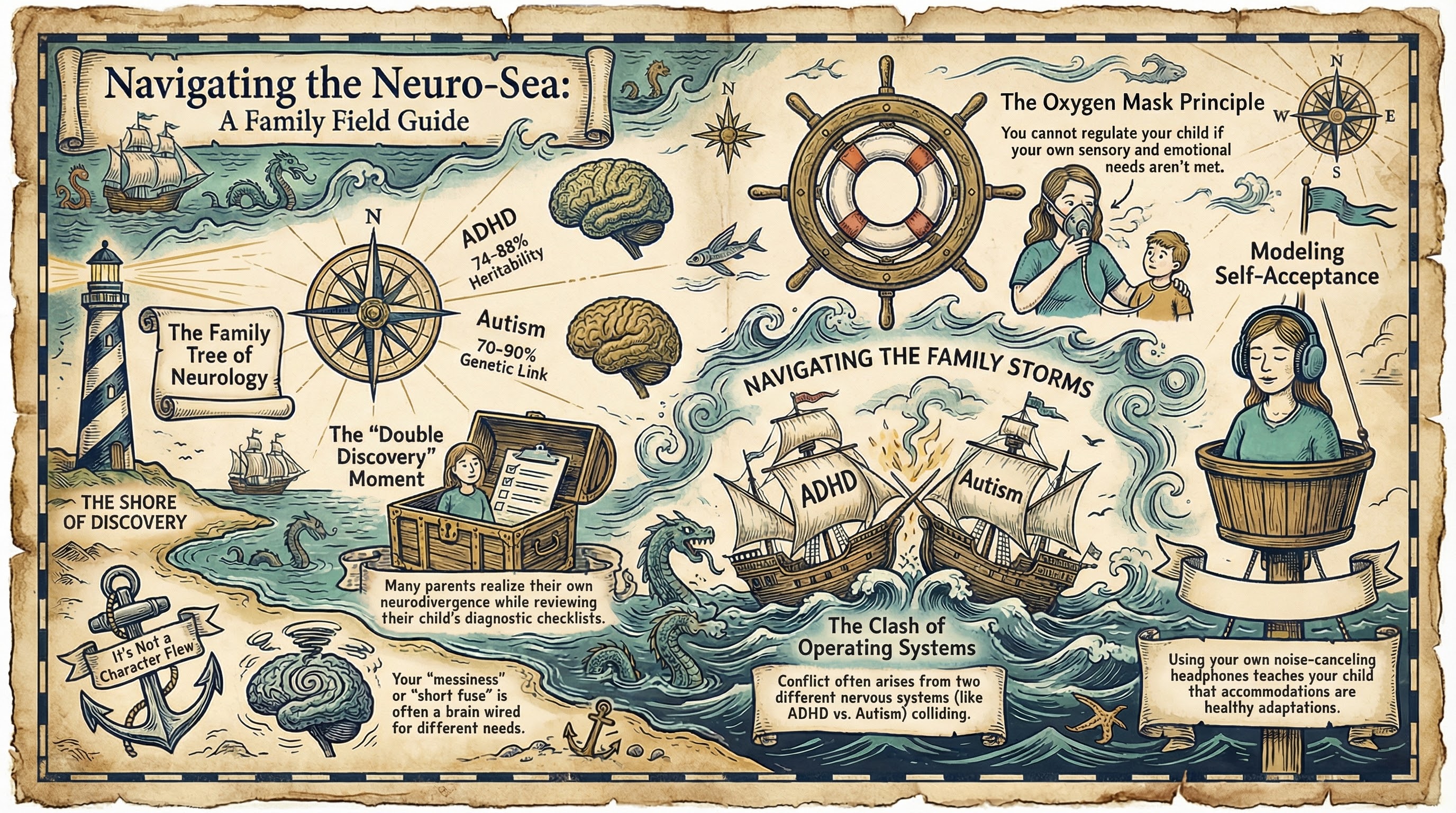
This Wasn't in the Brochure Co-Parenting ADHD, Autism, PDA & ODD
Preface: To the Neurodivergent Parent
This book is for you.
Not about you. Not for someone like you. For you.
If you're holding this book, the statistics suggest something you may have already suspected: you are likely neurodivergent yourself.
The numbers are not abstract. They are personal:
- ADHD heritability: 74-88%¹
- Autism heritability: 70-90%²
If your child has ADHD, there is a statistically high probability that you do too—diagnosed or not. If your child is autistic, one or both parents likely share traits on the spectrum. The apple doesn't fall far from the tree. The racecar engine was inherited. The Linux operating system runs in the family.
This book assumes you are navigating two maps simultaneously: your child's neurology and your own.
The Double Discovery
Many parents discover their own neurodivergence through their child's diagnosis.
You read the ADHD symptom checklist for your daughter and think, "Wait. I do that." You attend the autism assessment and the psychologist asks about your childhood sensory sensitivities. You watch your son's meltdown and recognize the exact dysregulation you've felt your entire life but never had words for.
This is called "the double discovery," and it is profoundly common.
You are not "taking attention away from your child" by exploring your own neurology. You are not "making it about you." You are completing your own map—and that makes you a better navigator for your child.
If you've spent this entire introduction thinking "this sounds like me," trust that instinct. This book validates what you've known all along: your "messiness" is not a character flaw. Your "short fuse" is not moral weakness. Your need for routine is not rigidity. Your sensory sensitivities are not "being dramatic."
That's your neurodivergent brain, doing exactly what it was wired to do.
The Voice Contract
Throughout this book, when we say "your executive function," we mean your brain—not just your child's.
When we talk about time-blindness, sensory overload, rejection sensitivity, demand avoidance, or emotional dysregulation, we are often describing your daily experience as much as your child's.
When we suggest accommodations—noise-canceling headphones, visual schedules, calendar alerts, tap-out protocols, stimming tools—many of them are for you, not just your child.
This is not a parenting book written by neurotypical experts about neurodivergent families. This is a field guide written by navigators who understand the terrain from the inside. We speak your language because we are you.
Why This Matters for Co-Parenting
Understanding your own neurodivergence is not optional—it is foundational to successful co-parenting.
Here's why:
1. You Stop Fighting Your Own Nature
If you have ADHD and you've spent years berating yourself for being "forgetful" or "lazy," you've been fighting a neurological reality. Once you understand that your brain processes time differently, you stop trying to willpower your way through it. You install external scaffolding: alarms, apps, visual cues. You accommodate yourself the same way you accommodate your child.
The mental load drops. The shame lifts. You become effective.
2. The "Clash of Operating Systems" Makes Sense
If you're an ADHD parent co-parenting with an autistic ex-partner, your conflicts may not be about "who's right." They may be about two different nervous systems colliding.
You thrive on novelty and spontaneity. They need predictability and routine. Your time-blindness feels like disrespect to them. Their rigidity feels controlling to you. Neither of you is wrong—you're running incompatible operating systems.
When you name the dynamic, you stop blaming each other. You start scaffolding for the difference instead of trying to "fix" each other.
3. You Model Self-Acceptance for Your Child
If your child sees you masking your stims, apologizing for your "quirks," or white-knuckling through sensory overload, they learn that neurodivergence is something to hide.
If they see you using noise-canceling headphones during the "witching hour," setting alarms for your own time-blindness, or openly saying "I need a sensory break," they learn that accommodations are healthy adaptations, not weakness.
You become the permission they need to accept themselves.
To the Undiagnosed Parent
You do not need a formal diagnosis to benefit from this book.
You do not need a psychiatrist's letter to use ADHD-friendly co-parenting apps, autistic-affirming sensory accommodations, or PDA-aware low-demand language.
But if you do seek adult assessment—for ADHD, autism, or both—know this:
Adult neurodivergent diagnosis is valid, valuable, and common in parents of neurodivergent children.
You are not "faking it." You are not "taking resources from kids." You are not "too old" or "too functional" to qualify. The diagnostic criteria were written for children, and many adults—especially women, people of color, and those who've spent decades masking—were overlooked.
Getting assessed is not about collecting labels. It's about understanding your operating manual. It's about accessing accommodations that make life livable. It's about finally having language for the invisible struggles you've carried alone.
And here's the radical truth: Understanding your neurodivergence makes you a better parent.
You stop trying to be the neurotypical parent you were never going to be. You stop fighting your executive function, your sensory system, your regulation capacity. You start designing a life—and a co-parenting structure—that works with your brain, not against it.
You become the guide who's walked the terrain, not the tour guide reading from a script.
What This Book Assumes About You
This book assumes:
- You are likely neurodivergent. (The statistics say so.)
- You are co-parenting in a separated or divorced context. (The relationship didn't survive the strain, and that's okay.)
- You are exhausted. (Chronic dysregulation is physiologically depleting.)
- You are doing your best. (Even when your best looks chaotic, inconsistent, or "not enough.")
- You want tools, not lectures. (You've had enough shame. You need scaffolding.)
We will not tell you to "try harder." We will not suggest meditation, kale smoothies, or "setting boundaries" as if those are simple acts of willpower.
We will give you external systems to replace the executive function you don't have. We will give you scripts for the social situations that short-circuit your brain. We will give you permission to tap out, to stim, to say no, to protect your nervous system.
Because you cannot regulate your child if you are dysregulated. You cannot be their external cortex if your own cortex is offline.
Taking care of your neurodivergent brain is not selfish. It is the oxygen mask principle.
A Note on Language
You will see us use "you" and "your" throughout this book—not as a generic stand-in for "parents," but as a direct address to you, the neurodivergent reader.
When we say "your time-blindness," we mean your brain's relationship with time. When we say "your sensory overload," we mean your nervous system's threshold. When we say "your rejection sensitivity," we mean your lifetime of small wounds that feel like mortal threats.
If a passage doesn't apply to you—if you're neurotypical or your neurodivergence presents differently—that's okay. Skip it. Take what fits. Leave the rest.
But if you find yourself thinking, "Wait, this is describing ME," over and over—that's the point.
We see you. We are you. Welcome home.
How to Use This Book
If you're in crisis:
Go to the Survival Card at the end of the relevant chapter. Each one gives you a protocol now—not a theory.
If you're newly diagnosed (or newly suspecting):
Start with Chapter 2: Understanding the Waters. It maps the neurology of ADHD, Autism, PDA, and ODD—for your child and for you.
If co-parenting feels impossible:
Jump to Chapter 3: Two Captains, One Ship. It addresses high-conflict co-parenting with neurodivergent dynamics.
If you just need to survive tomorrow morning:
Try Chapter 4: The Morning Passage. Routines, rituals, and external scaffolding for when executive function fails.
If you're drowning:
Read Chapter 9: The Caring Compass. Self-care for neurodivergent parents is not bubble baths. It's nervous system protection.
You do not have to read this book in order. It is designed as a field guide, not a novel. Use the table of contents. Flip to the chapter that matches your current storm.
One Last Thing
If you are neurodivergent, you have spent most of your life being told—implicitly or explicitly—that you are too much or not enough.
Too loud. Too sensitive. Too scattered. Too rigid. Too emotional. Too avoidant.
Not organized enough. Not focused enough. Not resilient enough. Not patient enough. Not "together" enough to parent.
That stops here.
Your ADHD brain is not a deficit. It is a high-powered engine that processes information at a velocity neurotypical brains cannot match. Yes, you need better brakes. That's what this book provides.
Your autistic brain is not broken. It is a specialized operating system capable of pattern recognition, depth of focus, and sensory perception that neurotypical brains lack. Yes, you need different inputs. That's what this book provides.
Your PDA profile is not "oppositional." It is a fierce autonomy drive and a survival-level need for control in a world that rarely feels safe. Yes, you need low-demand pathways. That's what this book provides.
You are not failing at parenting because of your neurodivergence. You are struggling because the system was not designed for you.
This book redesigns the system.
Let's begin.
Footnotes:
- ADHD Causes: Is ADHD Genetic? – ADDA – Attention Deficit Disorder Association, accessed on December 23, 2025, https://add.org/is-adhd-genetic/
- Autism Spectrum Disorder: Genetic Mechanisms and Inheritance Patterns – MDPI, accessed on December 23, 2025, https://www.mdpi.com/2073-4425/16/5/478
Table of Contents
Chapter 0: Navigator's Compass – Quick Reference Guide
Chapter 1: Cartographers of Uncharted Waters – An Invitation to the Voyage
Chapter 2: Understanding the Waters – ADHD, Autism, PDA, and ODD Explained
Chapter 3: Two Captains, One Ship – Building Your Co-Parenting Team
Chapter 4: The Morning Passage – Routines and Rituals for a Smooth Start
Chapter 5: Stormy Seas – Meltdowns, Tantrums, and Emotional Dysregulation
Chapter 6: Bridging Two Worlds – Transitions Between Homes
Chapter 7: School and Beyond – Charting a Course in the Outside World
Chapter 8: The Wider Village – Family, Friends, and Finding Support
Chapter 9: The Caring Compass – Self-Care for Co-Parents
Chapter 10: New Horizons – Adapting as Your Child Grows
Chapter 11: The Voyage Continues – A Neurodivergent Co-Parent's Manifesto
Appendix A: The Captain and the Crew (A Note on Neurodivergent Authorship and Writing with AI)
Appendix B: The Mariner's Dictionary (Glossary)
Appendix C: The Ship's Library (Resources)
Appendix D: Printable Tools & Templates
Appendix E: The Evidence Base
Appendix F: Works Cited
Appendix G: Transition Checklists by Age
Appendix H: Important Notices (Disclaimers, crisis resources, and acknowledgements)
Appendix I: Index