School and Beyond – Charting a Course in the Outside World
Preview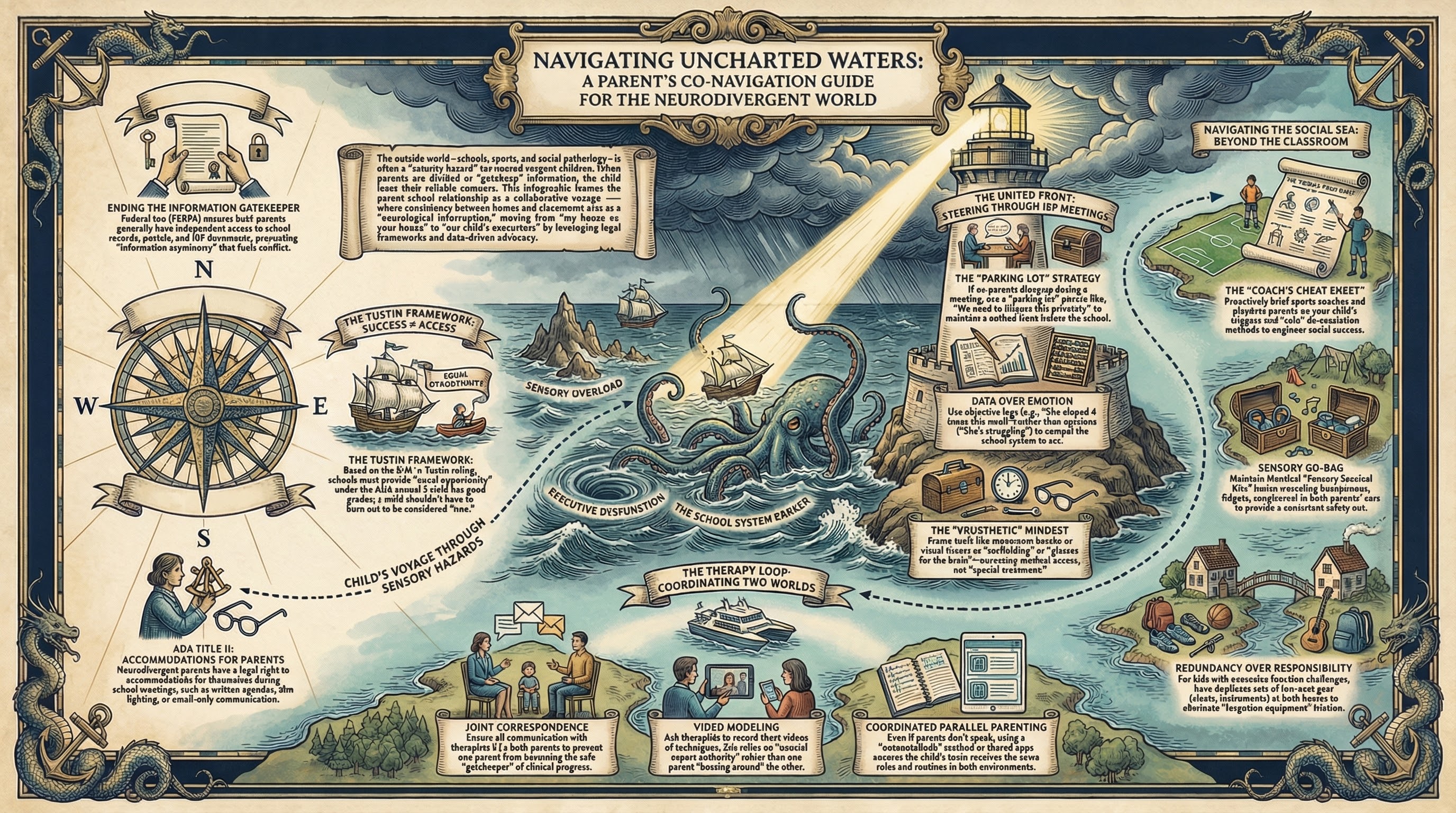

Quick Map: If you only read one page, read this
- The Ecosystem: View school not as a separate entity, but as part of your child’s neurological environment.
- Information Asymmetry: Prevent "gatekeeping" by ensuring both parents have independent access to school portals and IEP documents.
- The IEP Capstone: Present a unified, data-driven front in meetings. Use "parking lot" phrases to handle parental disagreements privately.
- Accommodations as Scaffolding: Frame supports like movement breaks and visual schedules as executive function "prosthetics," not crutches.
- Social Engineering: Proactively brief coaches and playdate parents using "Coach's Cheat Sheets" to set your child up for social success.
1. Charting Collaboration: United Fronts in Educational Waters
Navigating the educational and social systems outside the home represents one of the most treacherous yet potentially rewarding legs of the co-parenting voyage. For neurodivergent children—those with Attention Deficit Hyperactivity Disorder (ADHD), Autism Spectrum Disorder (ASD), Pathological Demand Avoidance (PDA), or Oppositional Defiant Disorder (ODD)—the world outside the family fortress is often uncharted waters, replete with sensory hazards, social hidden reefs, and institutional rigidities.
This chapter rests on a foundational cartographic principle: when co-parents operate as distinct, warring factions, the child is left without a reliable compass. Conversely, when parents—regardless of their marital status or the fluidity of their personal relationship—synchronize their navigational charts, they provide the triangulation necessary for the child to locate themselves safely in the world.
1.1 The Neurological Necessity of Consistency
The scientific imperative for a united front extends far beyond mere behavioral management or the reduction of household friction; it is rooted deeply in the neuroplasticity of the developing brain. Research consistently indicates that children with neurodevelopmental differences often struggle with executive functions, specifically cognitive flexibility, working memory, and emotional regulation.¹
The neurodivergent brain is frequently characterized by a heightened sensitivity to environmental inputs and a lower threshold for stress response activation. When two households present radically different expectations, vocabularies, and responses to the same behaviors, the cognitive load on the child increases exponentially.
Consider the autistic child or the child with a PDA profile, for whom the world is often perceived as chaotic, overwhelming, and unpredictable. For the neurodivergent child, routine and predictability are not merely preferences; they are the scaffolding upon which her sense of safety is built.
Continue Reading
Unlock the full content including Tactical Strategies, Parent Toolkit, and Survival Card.
Get Full AccessPay what you can - from $5