Bridging Two Worlds – Transitions Between Homes
Preview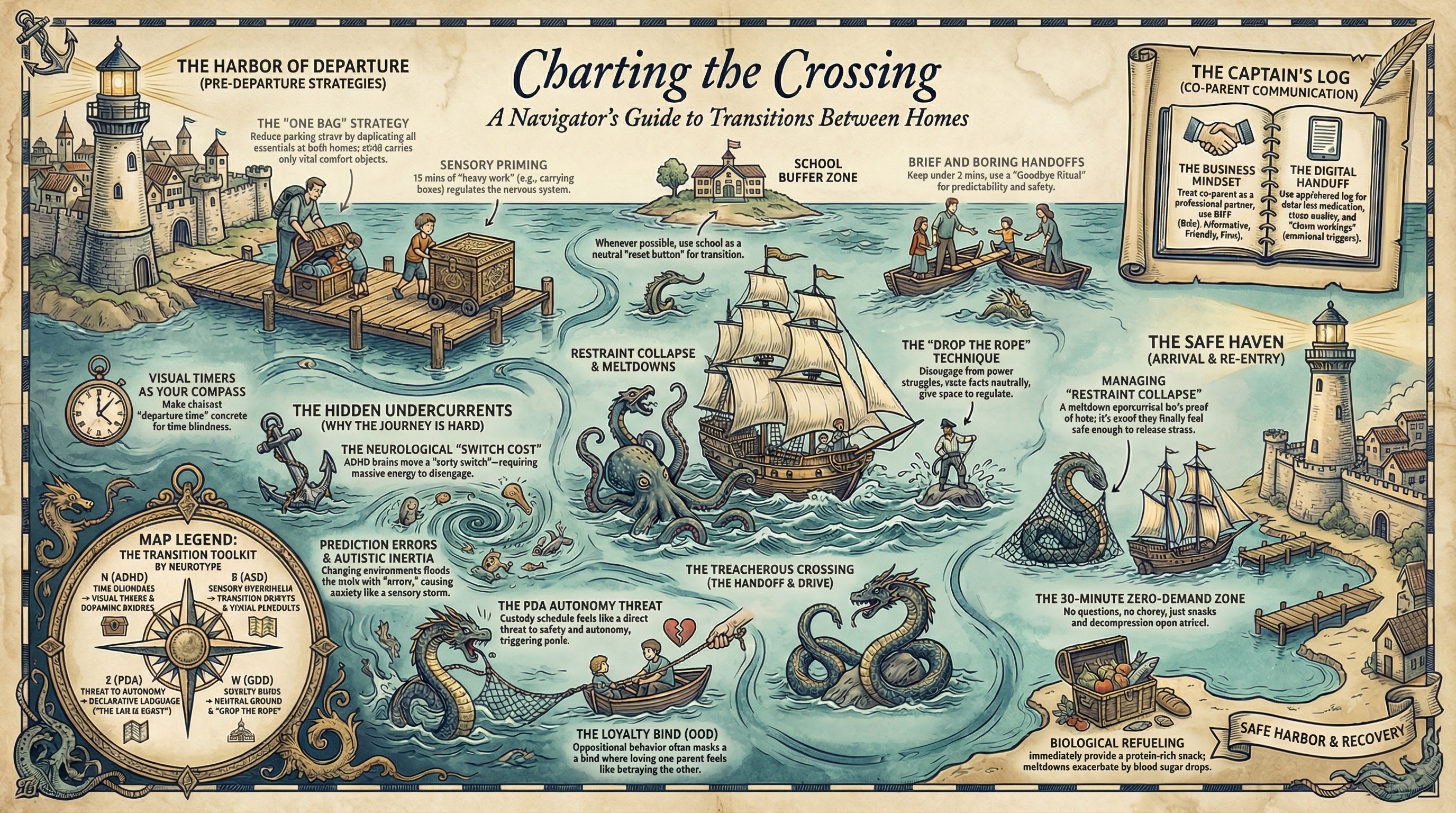

Quick Map: If you only read one page, read this
- The Switch Cost: Transitions aren't just logistical; they are neurologically expensive "context switches."
- The Buffer Zone: Build a 30-minute zero-demand period after arrival to prevent "Restraint Collapse."
- The Handoff: Use school as a neutral buffer or keep direct exchanges brief and boring.
- The One Bag: Duplicate essentials (chargers, toiletries) so the child only carries her comfort objects.
- The "Business" Mindset: Communicate with your co-parent like a professional partner, not an ex.
Field Guide: The Neurobiology of Transitions
What's happening in the brain/body: Transitions between homes aren't just physical movement—they're neurological "context switches" that cost massive cognitive energy. For ADHD, task-switching is expensive due to dopamine deficits and high "switch costs." Stopping a preferred activity (hyperfocus) feels like a crash. Time blindness means transitions feel sudden even when warned. For ASD, each home has its own predictive model (sounds, smells, textures). Switching homes floods the brain with "prediction errors," triggering anxiety and sensory overwhelm. Autistic inertia (a mind at rest stays at rest) makes initiating the transition physically difficult. For PDA, the custody schedule itself is a demand that triggers panic—"you must go because the court says so" feels like a threat to autonomy. For ODD, transitions activate the "loyalty bind" (loving one parent feels like betraying the other) and anticipatory anxiety about different rules/discipline.
What it looks like at home: Child refuses to pack, melts down at departure time, goes limp ("I can't move my legs"), screams in the car, or arrives at the other home and immediately has a massive meltdown ("restraint collapse"—held it together during the switch, falls apart when safe). May say "I hate going there" when she actually loves both homes—it's the transition she hates, not the destination.
What helps:
- Visual schedules (make time concrete for ADHD/ASD)
- Transition objects (familiar sensory item that travels between homes)
- Duplicate essentials (toiletries, chargers, clothes at both homes—reduces packing stress)
- Buffer zone (30-min zero-demand period after arrival for nervous system to recalibrate)
- Low-demand language for PDA ("Car leaves at 5" vs "Get in the car NOW")
- Neutral handoffs (school pickup, not face-to-face parent exchange)
What backfires:
- Springing transitions suddenly ("We're leaving in 5 minutes!" with no warning)
- Forcing face-to-face parent handoffs (high conflict = child's nervous system skyrockets)
- Lecturing during the car ride ("I expect you to behave at Mom's")
- Demanding immediate compliance at arrival ("Unpack your bag right now")
- Treating refusal as defiance when it's neurological paralysis
One sentence to remember: "The transition begins hours before departure and ends hours after arrival—it's a process, not a point in time."
Charting the Crossing: An Introduction to the Inter-Home Passage
For the neurodivergent child, the world is frequently experienced not as a seamless continuum, but as a fragmented archipelago of sensory experiences, social demands, and shifting expectations.
In the complex seascape of co-parenting, the transition between households—that physical and psychological movement from "Mom's world" to "Dad's world," or between any two caregiving environments—represents a seismic shift in these waters.¹
It is not merely a change of address or a logistical handover; it is a complete neurological reorientation, a profound "context switch" that demands immense cognitive and emotional energy. This chapter is your navigational guide through these often-treacherous channels. It explores the physiological, cognitive, and emotional undercurrents that make transitions particularly perilous for children with Attention Deficit Hyperactivity Disorder (ADHD), Autism Spectrum Disorder (ASD), Pathological Demand Avoidance (PDA), and Oppositional Defiant Disorder (ODD).
The transition between homes is frequently cited by family therapists, researchers, and exhausted parents alike as the flashpoint for high-conflict interactions and severe behavioral dysregulation.² For a child with a neurodevelopmental difference, this crossing is akin to navigating a heavily guarded customs checkpoint between two distinct cultures, each with its own language, sensory profile, dietary laws, and unwritten social codes.³ The strategies ahead aim to transform the "customs checkpoint" from a site of interrogation, anxiety, and meltdown into a bridge of safety and continuity.⁴
Continue Reading
Unlock the full content including Tactical Strategies, Parent Toolkit, and Survival Card.
Get Full AccessPay what you can - from $5