Leveraging the developmental neuroscience of caregiving to promote resilience among youth exposed to adversity.
Gee Dylan G, Cohodes Emily M
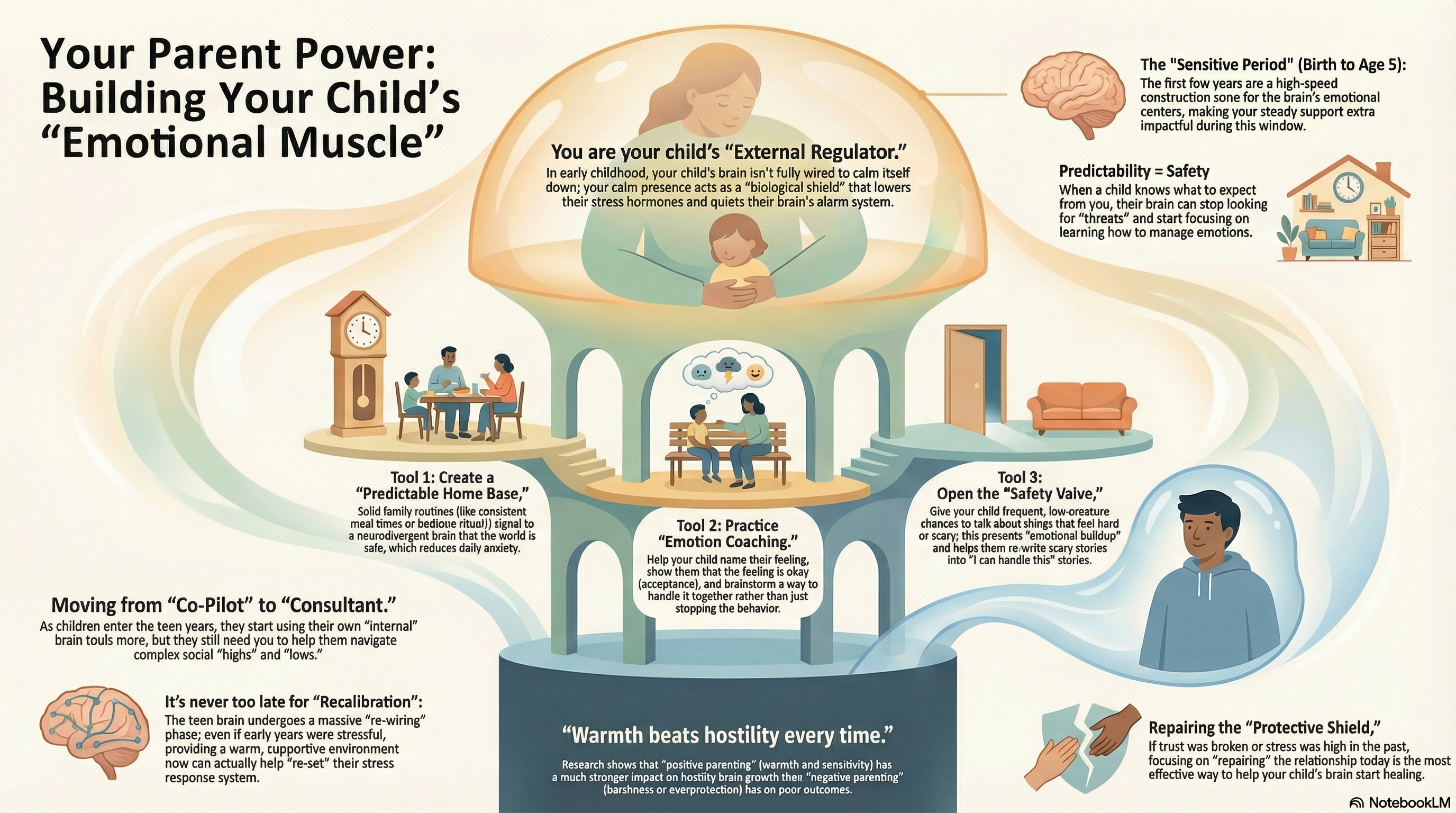
What This Paper Found
Researchers found that when a child faces stressful situations, a caregiver’s steady presence acts as a “biological scaffold.” Essentially, while a child’s brain is still developing the parts that manage emotions and stress, your brain steps in to do the heavy lifting for them. You aren’t just providing comfort; you are functioning as an external nervous system that helps their internal circuitry find its balance.
The study highlights that this isn’t a one-time event but a cumulative process. Consistent, supportive caregiving physically shapes the brain’s architecture over time. By acting as a calm harbor during their early years, you are helping them build the permanent internal machinery they need to eventually navigate life’s inevitable storms on their own.
Why This Matters for Your Family
For families navigating neurodivergent challenges like ADHD, Autism, or PDA, this research is a deep breath of validation. It suggests that even when you feel like you aren’t “fixing” a meltdown, your simple act of staying present and regulated is doing vital work under the surface. You don’t need to have a perfect solution for every crisis; you just need to be the steady keel that keeps the ship upright while your child learns to find their own center.
This is especially important for co-parents. When both captains agree to prioritize being that emotional anchor, it creates a predictable environment where a child’s brain feels safe enough to grow. It’s not about being perfect parents who never lose their cool—it’s about providing a consistent, safe baseline so that your child knows where home is, no matter how choppy the waters get.
What You Can Do Today
- Lend them your nervous system. When your child is spiraling, remember that they likely cannot regulate themselves yet. By focusing on your own slow, steady breathing and staying calm, you provide the external “scaffold” their brain needs to de-escalate and return to shore.
- Prioritize the “repair” after a storm. Since the physical shaping of the brain relies on secure attachment, the moments of connection after a difficult episode are incredibly powerful. Taking a moment to reconnect and reassure your child that they are safe and loved helps reinforce the neural pathways of resilience.
- Check your “scaffolding” as they grow. The researchers emphasize that support must change as children hit different developmental milestones. Sit down with your co-parent to discuss whether the way you provide support still fits your child’s current needs, or if it’s time to adjust your course for the next stage of the voyage.
The Original Paper
Gee, D. G., & Cohodes, E. M. (2021). Leveraging the developmental neuroscience of caregiving to promote resilience among youth exposed to adversity. Annual Review of Clinical Psychology.
Safety Note: This research summary is for informational purposes only and does not constitute medical or therapeutic advice. Always consult qualified professionals for your family’s specific situation. If you or your child are in crisis, contact your local emergency services or one of these helplines: 988 Suicide & Crisis Lifeline (US) | Lifeline Australia: 13 11 14 | Samaritans UK: 116 123 | Need to Talk? NZ: 1737
Research Brief
Generated by NotebookLM from the original paper. Not a replacement for the peer-reviewed source.
Read Full Brief →