Efficacy of guided and unguided web-assisted self-help for parents of children with attention-deficit/hyperactivity disorder and oppositional defiant disorder: A three-arm randomized controlled trial.
Döpfner Manfred, Plück Julia, Rosenberger Kerstin Daniela, Klemp Marie-Theres, Mühlenmeister Judith, Wähnke Laura, Hellmich Martin, Schürmann Stephanie, Dose Christina
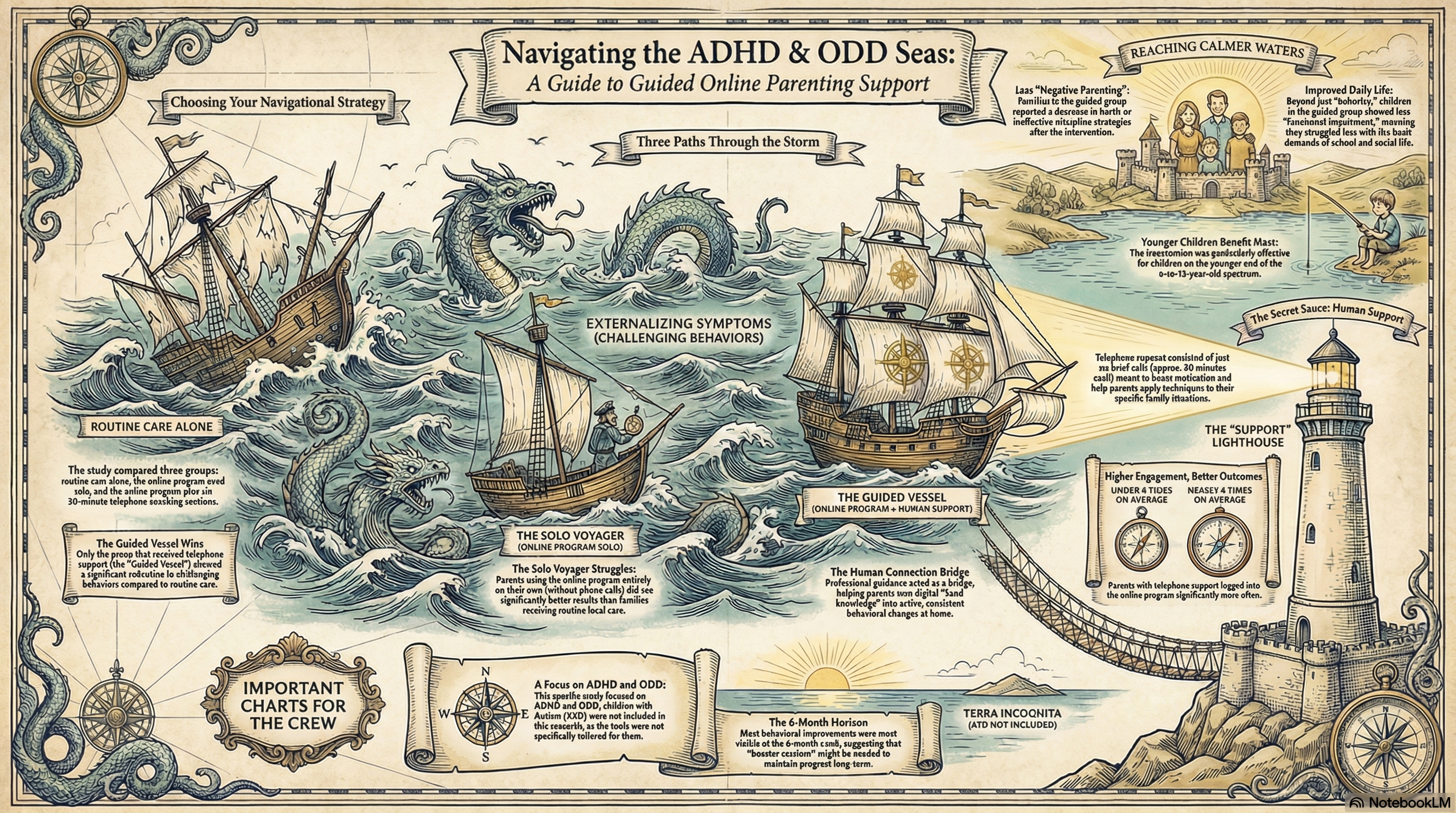
What This Paper Found
Research often confirms what we feel in our bones: parenting a neurodivergent child is a heavy lift, and doing it entirely alone is even harder. This study looked at “web-assisted self-help”—essentially online courses for parents of children with ADHD and ODD—to see if these digital tools actually help reduce difficult behaviors in school-age kids.
The researchers found that while online tools are helpful, they often work significantly better when there is a human being on the other end of the line. Parents who had access to telephone coaching sessions alongside the digital modules generally saw a much greater reduction in their child’s symptoms than those who tried to navigate the digital waters solo.
There was also a very practical “tipping point” discovered: parents didn’t need to be perfect to see results. Completing at least 40% of the program was the threshold where daily life started to feel more manageable. It is a helpful reminder that we don’t need to finish every single module to keep the ship on course; we just need enough consistency to reach that turning point.
Why This Matters for Your Family
For those of us managing meltdowns and the constant “no” that often comes with ODD, the idea of adding a course to our plate can feel overwhelming. However, this research suggests that professional support acts like a lighthouse. It isn’t just about learning generic “tips”; it’s often about having a navigator to help you apply those strategies to your specific, often unpredictable reality.
In a co-parenting relationship, this matters because it shifts the dynamic from “my way vs. your way” to a shared strategy supported by an outside expert. Having a neutral coach can help you and your co-parent align your compasses and reduce the friction that naturally happens when stress levels are high.
If you’ve tried an app or a book before and felt like it didn’t “work,” this study validates that experience. It wasn’t necessarily the information that was lacking, but perhaps the lack of a steady hand to help you steer through the hardest passages of your week.
What You Can Do Today
- Seek out programs with a “human” element. When looking for online support, you might find it more effective to choose options that include coaching calls or professional feedback rather than just a library of videos.
- Lower the bar for completion. Don’t let the pressure of “finishing” stop you from starting. Aim to get through roughly half the material (the 40% mark) to begin seeing real-world shifts in your child’s behavior.
- Use a coach to bridge the gap with your co-parent. If you are struggling to get on the same page, a professional coach can act as a neutral third party to help you both focus on the same map and shared goals.
The Original Paper
Döpfner, M., Plück, J., Rosenberger, K. D., Klemp, M. T., Mühlenmeister, J., Wähnke, L., Hellmich, M., Schürmann, S., & Dose, C. (2023). Efficacy of guided and unguided web-assisted self-help for parents of children with attention-deficit/hyperactivity disorder and oppositional defiant disorder: A three-arm randomized controlled trial.
Safety Note: This research summary is for informational purposes only and does not constitute medical or therapeutic advice. Always consult qualified professionals for your family’s specific situation. If you or your child are in crisis, contact your local emergency services or the 988 Suicide & Crisis Lifeline.
Research Brief
Generated by NotebookLM from the original paper. Not a replacement for the peer-reviewed source.
Read Full Brief →