Parent training tailored for parents with ADHD: a randomized controlled trial.
Lindström Therese, Buddgård Sofia, Westholm Lena, Forster Martin, Bölte Sven, Hirvikoski Tatja
What This Paper Found
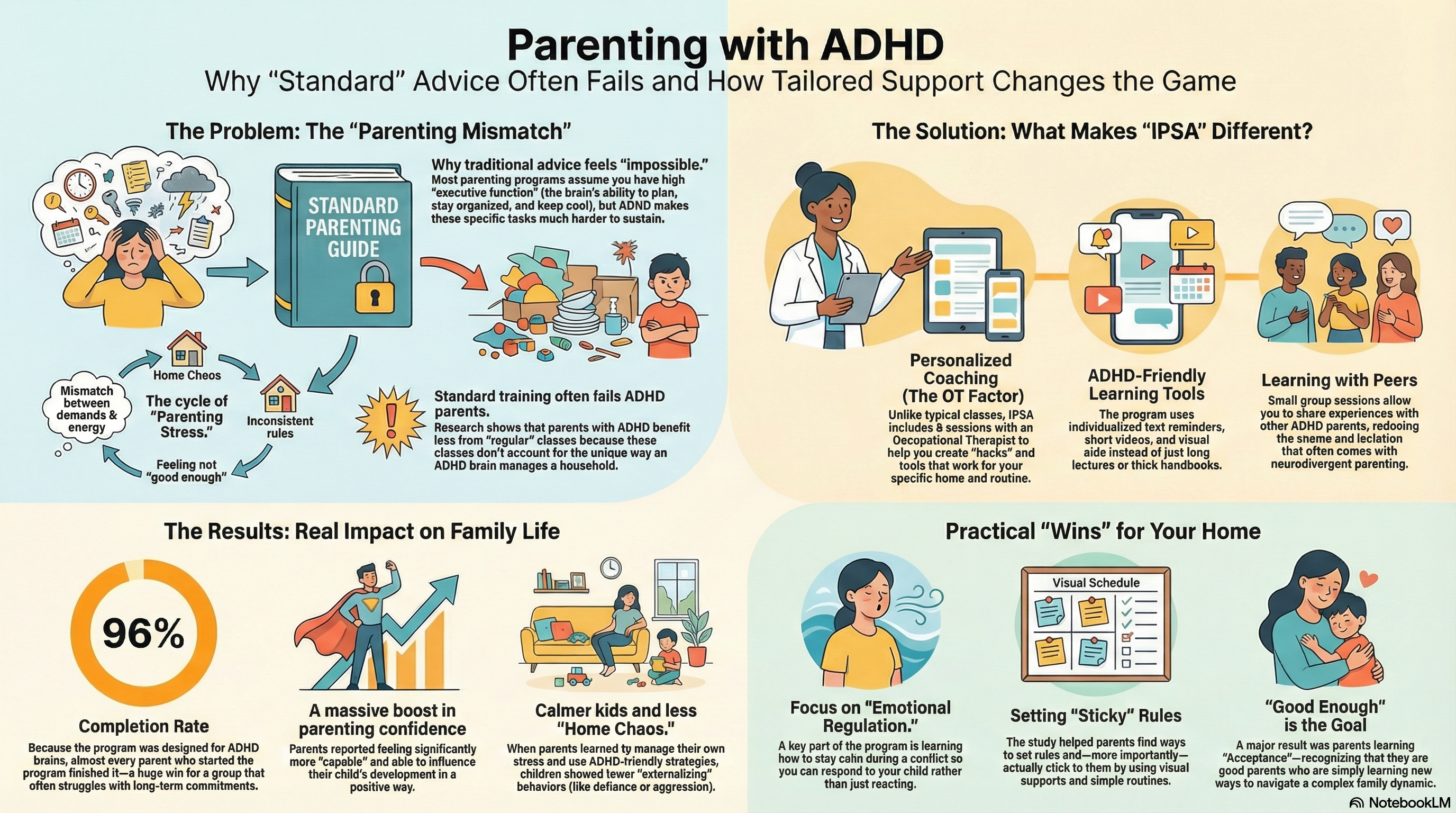
Standard parenting programs often feel like they were written for a different species. This research confirms what many of us have felt: conventional “parent training” often fails parents who have ADHD themselves. Because these programs usually rely on high-level executive functions—like long-term planning, consistent tracking, and complex organization—they can inadvertently increase the stress they are supposed to solve.
The researchers tested a specific program called IPSA (Improving Parenting Skills Adult ADHD). Unlike standard courses, this was tailored for the way an ADHD brain actually works. The study found that when the training accounted for the parent’s own needs, it significantly boosted parenting confidence and reduced daily household friction. It turns out that the “captain” of the ship doesn’t need to work harder; they just need a compass designed for the waters they are actually in.
Why This Matters for Your Family
If you are an ADHD parent raising a neurodivergent child, you are often navigating two sets of complex needs at once. This study validates that “failing” at a standard parenting strategy isn’t a character flaw; it’s a manual mismatch. When you try to force a neurotypical system into an ADHD household, it often leads to a cycle of shame and burnout for both the parents and the kids.
For co-parents, this is a game-changer. It means that the “consistent” approach your partner might be pushing for—or that you’re trying to force on yourself—might need to be redesigned to fit your specific cognitive profile. When the ADHD parent gets the right support, emotional regulation improves for the whole family. You stop fighting your own wiring and start building a “vessel” that can actually handle the choppy seas of neurodivergent life.
What You Can Do Today
- Externalize your systems. Since ADHD can make “holding the plan” in your head feel impossible, use visual cues, shared digital timers, or “launch pads” by the door to handle the heavy lifting of your working memory.
- Put on your own oxygen mask first. Recognize that your ability to help your child regulate depends on your own sensory and executive function capacity; if you feel yourself “capsizing,” it is okay to step away for five minutes to reset before engaging.
- Audit your “shoulds.” If a parenting strategy—like a complex sticker chart or a rigid 12-step morning routine—feels physically painful to maintain, give yourself permission to throw it overboard and find a simpler, “good enough” workaround that actually sticks.
The Original Paper
Lindström, T., Buddgård, S., Westholm, L., Forster, M., Bölte, S., & Hirvikoski, T. (2023). Parent training tailored for parents with ADHD: a randomized controlled trial.
Safety Note: This research summary is for informational purposes only and does not constitute medical or therapeutic advice. Always consult qualified professionals for your family’s specific situation. If you or your child are in crisis, contact your local emergency services or the 988 Suicide & Crisis Lifeline.
Research Brief
Generated by NotebookLM from the original paper. Not a replacement for the peer-reviewed source.
Read Full Brief →