Parent, child, and family outcomes following Acceptance And Commitment Therapy for parents of autistic children: A randomized controlled trial.
Maughan Andrea L, Lunsky Yona, Lake Johanna, Mills Jennifer S, Fung Kenneth, Steel Lee, Weiss Jonathan A
What This Paper Found
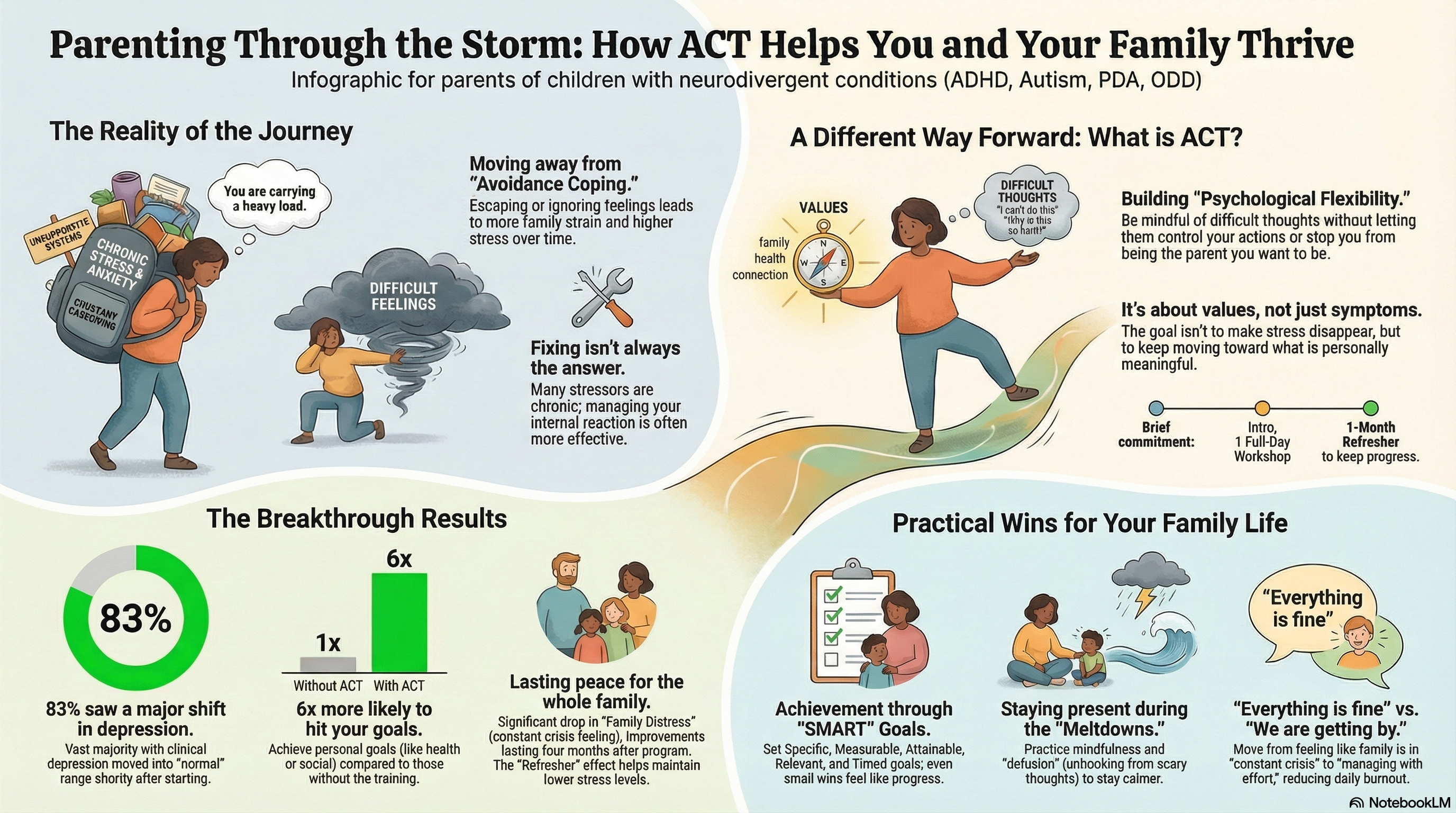
Researchers recently looked at how a brief group program based on Acceptance and Commitment Therapy (ACT) helps parents of autistic people across a wide age range—from toddlers to adults. The study focused on “psychological flexibility,” which is a fancy way of describing our ability to stay present and open to difficult thoughts without letting them steer our ship into the rocks. Instead of trying to eliminate stress, ACT teaches us how to carry it differently.
The results showed that parents who participated in the program saw significant drops in depression and overall family distress. These weren’t just fleeting changes; the improvements were still there four months after the program ended. Parents also reported feeling more positive and found it easier to make progress on their own personal goals, which can often feel like they’ve been lost at sea.
Why This Matters for Your Family
When we are co-parenting neurodivergent children, it’s easy to fall into the trap of thinking we can only be “okay” once our child is “regulated.” This research suggests that focusing on our own mental resilience can actually lower the distress levels for the entire household. When the co-captains of the family learn how to navigate their own internal storms, it creates a steadier environment for everyone on board, including our children.
This is especially helpful for the co-parenting relationship. When we stop reacting out of pure exhaustion or “guru certainty” and start practicing mindful acceptance, we can communicate more clearly. It moves the conversation away from “Who is to blame for this meltdown?” and toward “How do we support each other through this wave?” It reminds us that our own well-being isn’t a luxury—it’s a vital part of the family’s navigation equipment.
What You Can Do Today
-
Label your heavy thoughts without trying to “fix” them. When a difficult thought like “I’m failing at this” bubbles up, try saying, “I am noticing that I’m having the thought that I’m failing.” This creates a small, vital gap between you and the storm, making the thought feel less like an absolute truth.
-
Identify one tiny personal goal that has nothing to do with parenting. The study found that ACT helped parents reclaim their own identities. Whether it’s listening to a favorite podcast for ten minutes or texting a friend, choose one small action today that serves you as an individual, not just as a caregiver.
-
Practice “values-based” co-parenting during a calm moment. Instead of debating rules, talk with your co-parent about a shared value, like “patience” or “connection.” When things get chaotic later, you can ask, “Is what we’re doing right now helping us move toward the horizon we agreed on?”
The Original Paper
Maughan, A. L., Lunsky, Y., Lake, J., Mills, J. S., Fung, K., Steel, L., & Weiss, J. A. (2024). Parent, child, and family outcomes following Acceptance And Commitment Therapy for parents of autistic children: A randomized controlled trial. Journal of Autism and Developmental Disorders.
Safety Note: This research summary is for informational purposes only and does not constitute medical or therapeutic advice. Always consult qualified professionals for your family’s specific situation. If you or your child are in crisis, contact your local emergency services or one of these helplines: 988 Suicide & Crisis Lifeline (US) | Lifeline Australia: 13 11 14 | Samaritans UK: 116 123 | Need to Talk? NZ: 1737
Research Brief
Generated by NotebookLM from the original paper. Not a replacement for the peer-reviewed source.
Read Full Brief →