The Parent-Child Relationship and Posttreatment Child Outcomes Across Two Treatments for Oppositional Defiant Disorder.
Booker Jordan A, Capriola-Hall Nicole N, Greene Ross W, Ollendick Thomas H
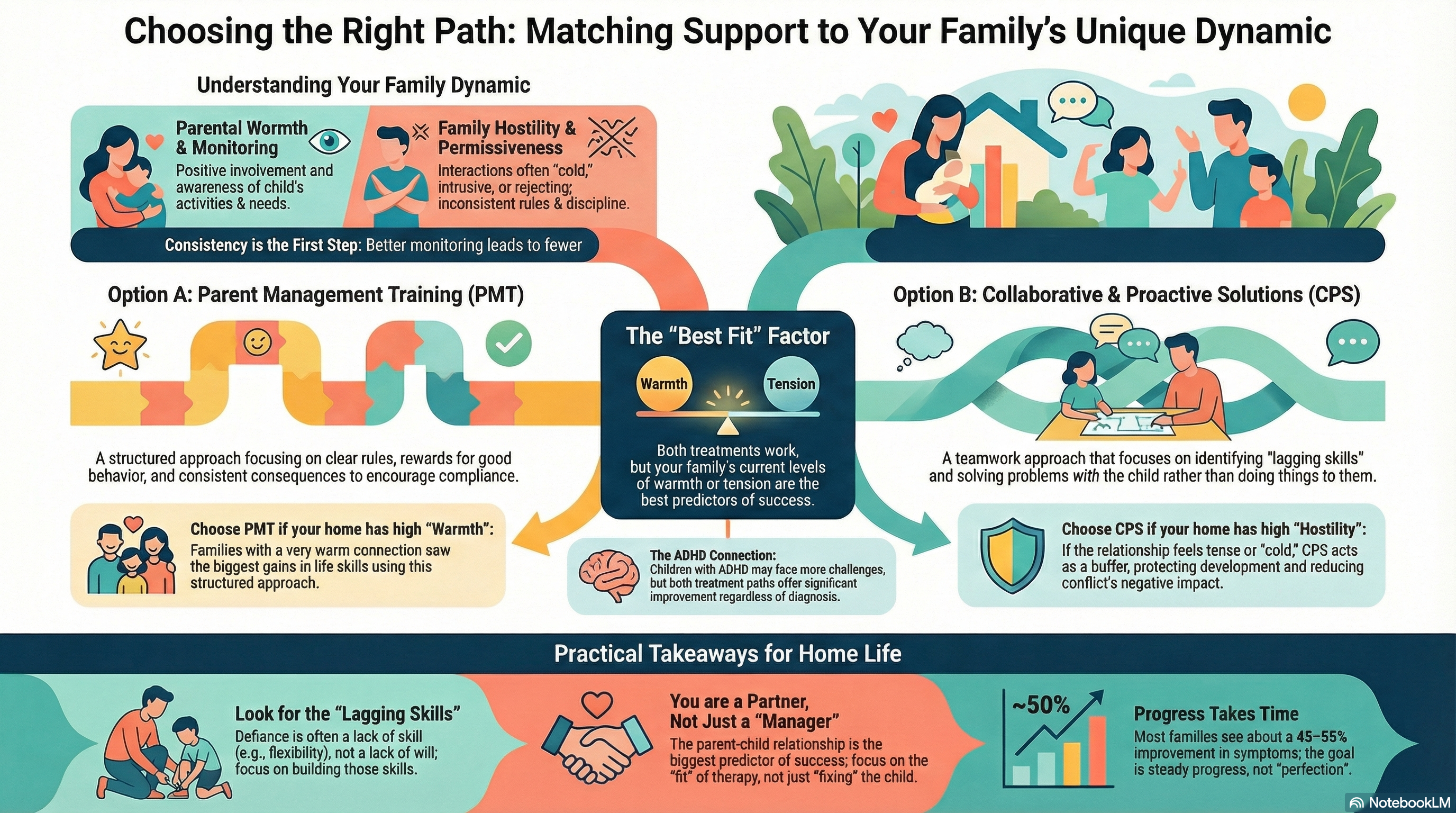
What This Paper Found
Researchers followed 134 families navigating the choppy waters of an Oppositional Defiant Disorder (ODD) diagnosis. They wanted to know if the quality of the parent-child bond actually changed how well different treatments worked. They compared two distinct approaches: one focused on managing behavior through structure and consequences, and the other (Collaborative and Proactive Solutions, or CPS) focused on solving problems together.
What they discovered is both grounding and hopeful. The warmth and steady guidance you provide—your role as a calm captain—is the strongest predictor of whether your child learns new ways to handle their world. They found that a strong, positive relationship isn’t just a “nice to have”; it is the primary engine that makes any parenting strategy effective. When the bond is strong, the child is better able to develop the adaptive skills they need to thrive.
Why This Matters for Your Family
When you’re dealing with intense ODD behaviors, it’s easy to feel like you’re just trying to keep the ship from sinking. We often focus so much on the behavior itself that we forget the relationship is the foundation. This research reminds us that there isn’t a one-size-fits-all map for every family. If your current approach feels like a constant battle of wills, it might be a sign that the strategy isn’t matching the current climate of your home.
For co-parents, this is a vital signal. The study found that for families where tension and conflict are high, the collaborative approach (CPS) acts as a better buffer for the child’s development. If you and your co-parent find yourselves stuck in a cycle of “enforcer vs. negotiator,” focusing on the quality of the bond first—making sure the child feels seen and heard—is what allows the actual parenting strategies to take hold. It’s about choosing the right gear for the weather you’re actually in.
What You Can Do Today
- Audit your “warmth” ratio. In the middle of ODD storms, we often become “instruction machines.” Try to find three moments today to offer a genuine, non-contingent connection—a shared joke, a specific observation of their effort, or just sitting nearby—without asking for a single task in return.
- Invite them to the chart table. If there is a recurring conflict (like the morning routine), wait for a calm moment and ask, “I’ve noticed we’ve been having a hard time getting out the door lately. What’s that like for you?” Listening to their side of the struggle without jumping to “correction” is the first step of collaborative problem-solving.
- Align with your co-parent on “regulation over compliance.” If the household tension is reaching a breaking point, agree to prioritize de-escalation and connection for the next 48 hours. Shifting the goal from “making them listen” to “helping them feel safe” can help lower the temperature for everyone involved.
The Original Paper
Booker, J. A., Capriola-Hall, N. N., Greene, R. W., & Ollendick, T. H. (2020). The Parent-Child Relationship and Posttreatment Child Outcomes Across Two Treatments for Oppositional Defiant Disorder. Journal of Clinical Child & Adolescent Psychology.
Safety Note: This research summary is for informational purposes only and does not constitute medical or therapeutic advice. Always consult qualified professionals for your family’s specific situation. If you or your child are in crisis, contact your local emergency services or one of these helplines: 988 Suicide & Crisis Lifeline (US) | Lifeline Australia: 13 11 14 | Samaritans UK: 116 123 | Need to Talk? NZ: 1737
Research Brief
Generated by NotebookLM from the original paper. Not a replacement for the peer-reviewed source.
Read Full Brief →