"Life is Much More Difficult to Manage During Periods": Autistic Experiences of Menstruation.
Steward Robyn, Crane Laura, Mairi Roy Eilish, Remington Anna, Pellicano Elizabeth
What This Paper Found
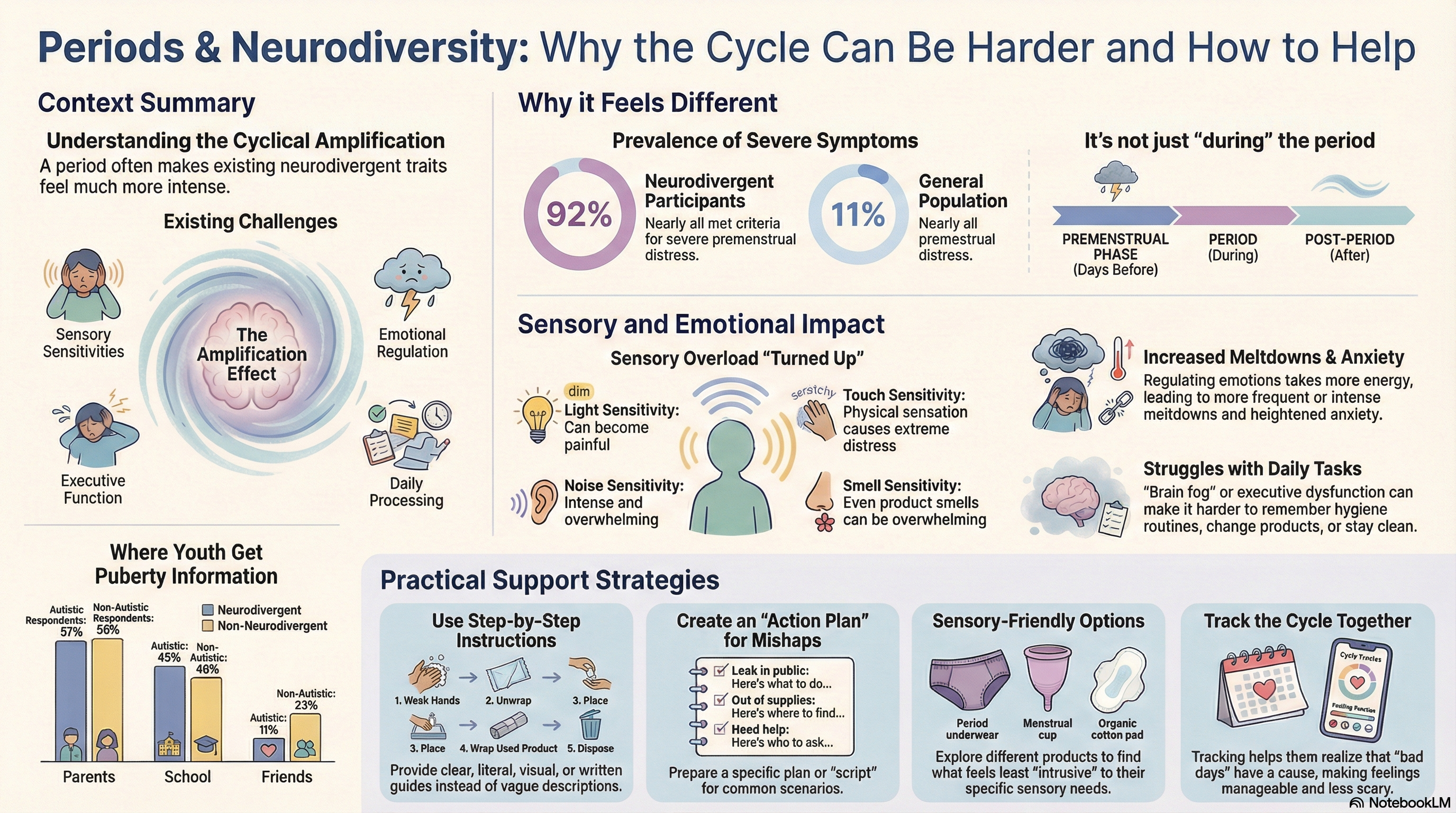
This research highlights something many parents have long suspected: menstruation isn’t just a physical process for autistic individuals; it can feel like a sudden shift in the internal weather that makes navigating daily life much harder. The researchers found that for many autistic people, the arrival of a period brings a “cyclical amplification” of their usual challenges. This means that sensory sensitivities—like the texture of clothes or the volume of the TV—can suddenly become unbearable, and the ability to regulate emotions can feel like it’s been swept away by a sudden high tide.
While everyone’s experience is different, the study showed that autistic respondents often face more intense distress than non-autistic people. It isn’t just about physical discomfort; it’s about a systematic increase in the very things that make the world feel overwhelming. For many, this includes a higher risk of severe premenstrual symptoms, making the days leading up to a period feel like trying to steer a ship through a gale with a broken rudder.
Why This Matters for Your Family
When we see a child’s behavior shift—more meltdowns, less flexibility, or a sudden withdrawal—it’s easy to panic and wonder if we’ve hit a permanent regression. This paper offers a different perspective: these might be predictable, hormonal waves rather than a change in the destination of your voyage. Understanding this helps us move from asking “What is wrong?” to “Where are we in the cycle?” This shift in focus can lower the temperature for everyone in the house and stop us from pathologizing a natural, albeit difficult, process.
For co-parents, this information is a vital part of your shared charts. If one captain is bracing for a sensory-sensitive week while the other assumes everything is “business as usual,” the child can end up caught in the crosscurrents between two different sets of expectations. Sharing this data between homes ensures that both parents can adjust demands and provide the extra “harbor” time a child might need during these intense windows, keeping the co-parenting relationship steady even when the internal waters are choppy.
What You Can Do Today
- Start a shared cycle log. Use a simple app or a shared calendar to track the dates of menstruation alongside “high-intensity” days to see if a pattern emerges. Knowing a difficult week is approaching allows you and your co-parent to plan lower-demand activities and adjust expectations in advance.
- Audit the sensory environment. During the week before and during a period, proactively reduce sensory input. This might mean using dimmer lights, offering noise-canceling headphones more frequently, or switching to “safe” sensory-friendly clothes, even if they aren’t the usual choice for school or outings.
- Hold a “Low-Demand” check-in. If the cycle suggests a difficult window is coming, touch base with your co-parent to simplify handovers and reduce extracurricular pressure. It is okay to skip a practice or a social event if it means preserving the child’s emotional energy and maintaining stability across both homes.
The Original Paper
Steward, R., Crane, L., Roy, E. M., Remington, A., & Pellicano, E. (2018). “Life is Much More Difficult to Manage During Periods”: Autistic Experiences of Menstruation. Journal of Autism and Developmental Disorders.
Safety Note: This research summary is for informational purposes only and does not constitute medical or therapeutic advice. Always consult qualified professionals for your family’s specific situation. If you or your child are in crisis, contact your local emergency services or one of these helplines: 988 Suicide & Crisis Lifeline (US) | Lifeline Australia: 13 11 14 | Samaritans UK: 116 123 | Need to Talk? NZ: 1737
Research Brief
Generated by NotebookLM from the original paper. Not a replacement for the peer-reviewed source.
Read Full Brief →