Stress among Parents of Children with and without Autism Spectrum Disorder: A Comparison Involving Physiological Indicators and Parent Self-Reports.
Padden Ciara, James Jack E
What This Paper Found
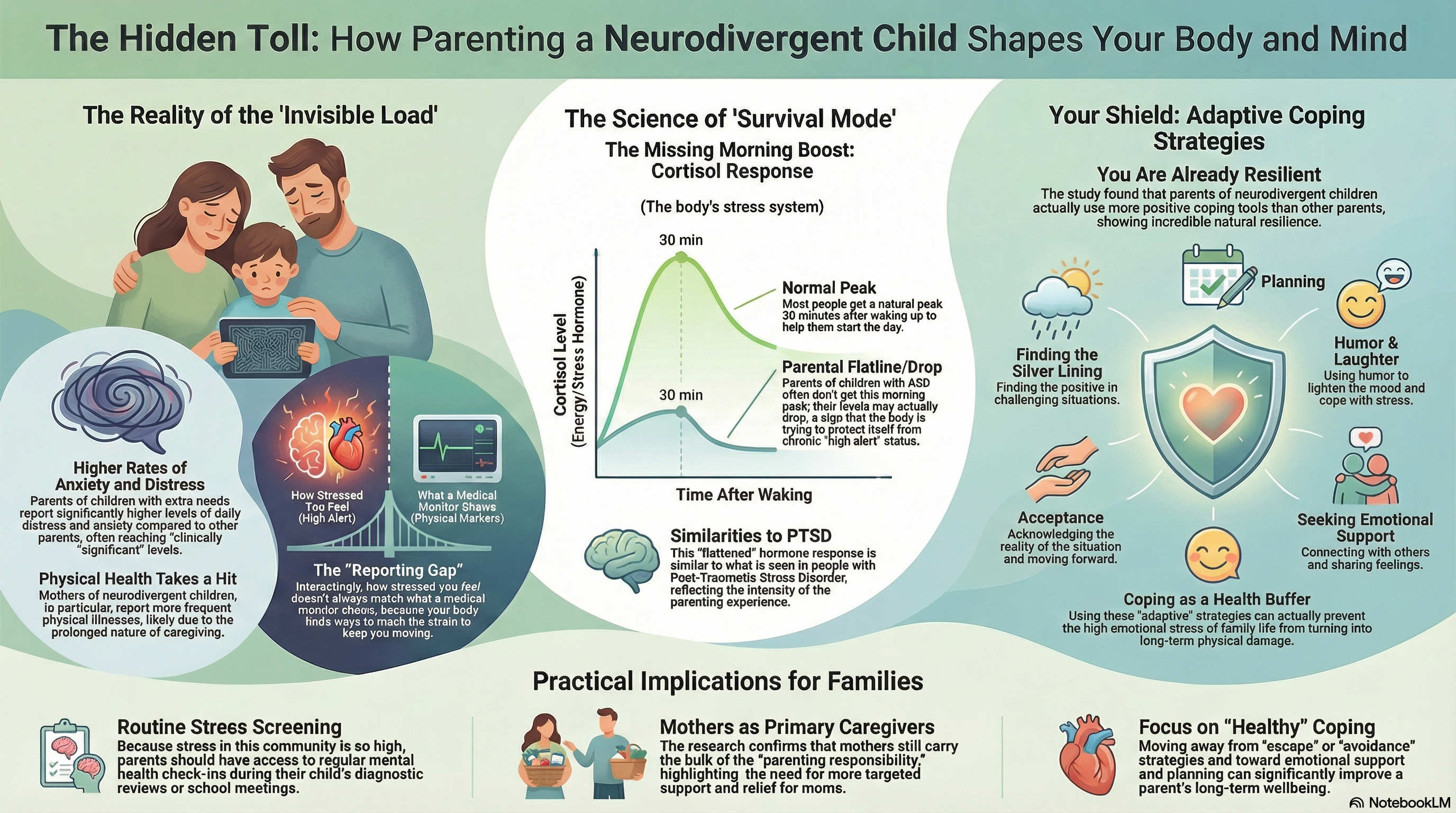
For a long time, we’ve known that parenting an autistic child feels different. We’ve felt the weight of the extra advocacy, the sensory scanning, and the constant mental load. This study confirms that those feelings aren’t just “in your head.” Researchers matched parents of autistic children with those of typically developing kids and looked beyond just surveys. They measured heart rates, blood pressure, and stress hormones like cortisol to see how the body was actually responding to the daily voyage.
The results were clear: parents of autistic children carry a significantly higher physiological load. Even when parents reported feeling relatively “okay” in terms of their physical health, their internal stress markers told a different story. It’s as if the ship’s hull is under immense pressure from deep-sea currents, even when the weather on the surface looks manageable.
Why This Matters for Your Family
This validation is vital because so much of our struggle is invisible. You might feel like you’re “holding it together” because you aren’t physically ill, but your body may be operating in a state of chronic high alert. When we understand that our stress is a measurable, biological reality, we can stop blaming ourselves for feeling exhausted. It isn’t a lack of willpower; it’s a physiological response to a more demanding passage.
For co-parents, this research offers a shared compass. When one of you is flagging, it helps to remember that the “burnout” isn’t a personality flaw—it’s a physical signal that the vessel needs time in a quiet harbor. Recognizing that both captains are navigating these same high-pressure waters allows for more empathy and less comparison of who is “working harder.”
What You Can Do Today
- Acknowledge the biological reality. Remind yourself (and your co-parent) that the fatigue you feel is a scientifically validated response to your unique environment, not a sign that you are failing as a navigator.
- Seek out emotional harbors. The study highlights that adaptive coping—like finding a supportive community or talking through the “hard”—is a vital tool for regulating those physical stress markers.
- Watch for “low tide” signals. If you find yourself feeling unusually flat or unmotivated in the mornings, it may be your body signaling that your stress hormones are depleted; treat this as a cue to simplify your schedule and lower the sails for a few hours.
The Original Paper
Padden, C., & James, J. E. (2017). Stress among Parents of Children with and without Autism Spectrum Disorder: A Comparison Involving Physiological Indicators and Parent Self-Reports. Journal of Autism and Developmental Disorders.
Safety Note: This research summary is for informational purposes only and does not constitute medical or therapeutic advice. Always consult qualified professionals for your family’s specific situation. If you or your child are in crisis, contact your local emergency services or one of these helplines: 988 Suicide & Crisis Lifeline (US) | Lifeline Australia: 13 11 14 | Samaritans UK: 116 123 | Need to Talk? NZ: 1737
Research Brief
Generated by NotebookLM from the original paper. Not a replacement for the peer-reviewed source.
Read Full Brief →