Emotion dysregulation in attention deficit hyperactivity disorder.
Shaw Philip, Stringaris Argyris, Nigg Joel, Leibenluft Ellen
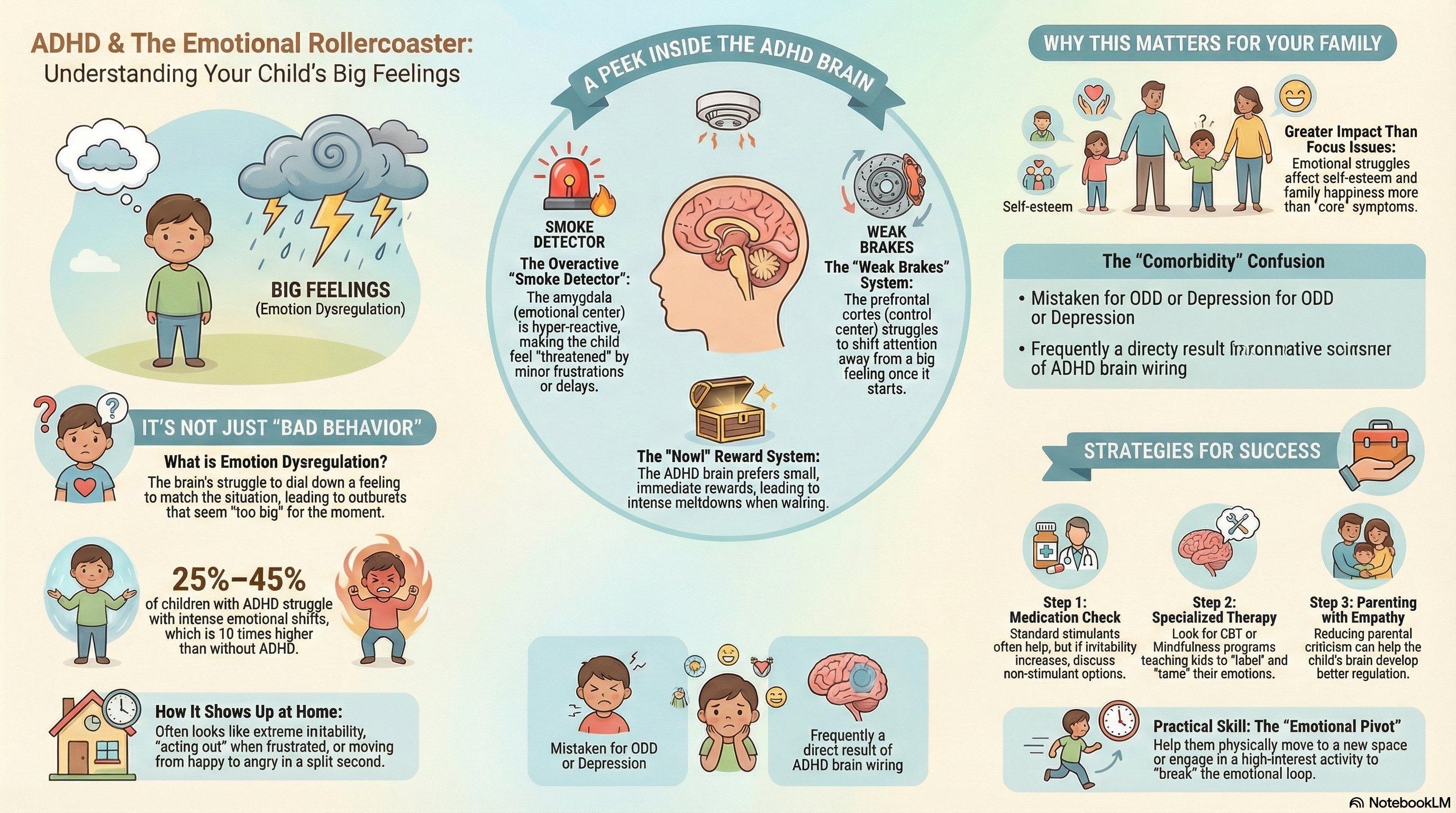
What This Paper Found
If you’ve ever felt like your child’s emotions are a sudden storm that blows in without warning, you aren’t alone. Researchers have found that “emotion dysregulation”—those big, fast shifts in mood or intense irritability—is actually a major part of the ADHD experience for many people. It isn’t just a side effect or a “behavior problem”; it’s a fundamental piece of how the ADHD brain is wired.
The study highlights that these emotional waves often come from how the brain directs its attention. Instead of just struggling to focus on homework, the ADHD brain can struggle to orient toward or recognize emotional signals correctly. This happens in specific networks of the brain that handle how we react to the world around us, making it harder to dial down an intense feeling once it starts.
Why This Matters for Your Family
Understanding this research can change the way we look at a meltdown or a sudden burst of anger. When we see these moments as part of the ADHD “equipment” rather than a choice or a parenting failure, it lowers the temperature for everyone on deck. It allows us to stop asking “Why are they doing this?” and start asking “What does their nervous system need right now?”
For co-parents, this research is a vital tool for staying on the same course. When both captains recognize that emotional storms are a core symptom of ADHD, it’s easier to support each other instead of blaming one another’s parenting style. It shifts the focus from “fixing” a child’s temper to building a ship that can handle the rougher waters together through shared strategies and validation.
What You Can Do Today
- Shift your lens from behavior to biology. Remind yourself (and your co-parent) that a big emotional reaction is often a “brain glitch” in processing information, not a calculated defiance tactic.
- Narrate the emotional weather. Help your child name what’s happening by saying things like, “It looks like a big wave of frustration is hitting right now,” which helps them build the recognition skills the research mentions.
- Audit your transitions together. Since the ADHD brain struggles to orient attention, give extra “port of entry” warnings before switching activities to help prevent the emotional friction that often leads to a storm.
The Original Paper
Shaw, P., Stringaris, A., Nigg, J., & Leibenluft, E. (2014). Emotion dysregulation in attention deficit hyperactivity disorder. American Journal of Psychiatry.
Safety Note: This research summary is for informational purposes only and does not constitute medical or therapeutic advice. Always consult qualified professionals for your family’s specific situation. If you or your child are in crisis, contact your local emergency services or one of these helplines: 988 Suicide & Crisis Lifeline (US) | Lifeline Australia: 13 11 14 | Samaritans UK: 116 123 | Need to Talk? NZ: 1737
Research Brief
Generated by NotebookLM from the original paper. Not a replacement for the peer-reviewed source.
Read Full Brief →