Frontostriatal involvement in task switching depends on genetic differences in d2 receptor density.
Stelzel Christine, Basten Ulrike, Montag Christian, Reuter Martin, Fiebach Christian J
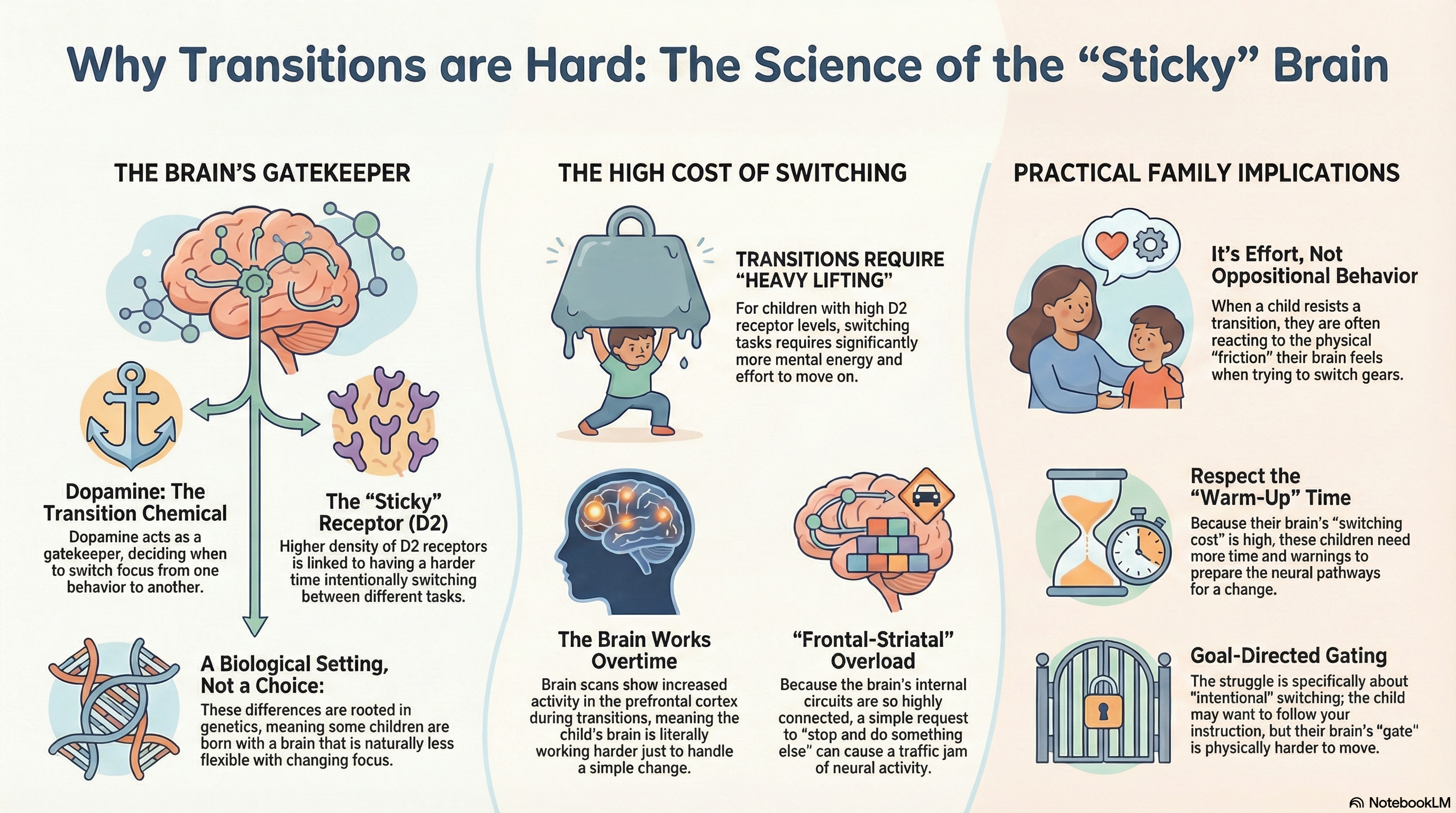
What This Paper Found
Ever feel like your child is “stuck” in an activity, and asking them to move to the next thing is like trying to turn a massive cargo ship in a narrow canal? This study helps explain why some of us find transitions so much harder than others. Researchers found that our genetic makeup—specifically how our brains handle dopamine—dictates how much physical effort it takes to switch tasks.
For some people, the brain has to work significantly harder to “unlock” from one behavior and “lock” into another. It’s not about willpower or being difficult; it’s about a biological “switching cost.” The study showed that certain genetic traits lead to increased activity in the brain’s command center just to manage a simple transition, meaning the “gear shift” between activities is actually a heavy lift for their neurology.
Why This Matters for Your Family
When we understand that transitions aren’t just a choice but a physical demand on the brain, the way we view “defiance” changes. If your child melts down when it’s time to leave the park, they might be experiencing a neurological logjam where their brain is struggling to re-route its energy. It’s like asking a sailor to change course in a gale without giving them any time to adjust the sails.
For co-parents, this research is a vital tool for staying on the same page. When both captains recognize that a child’s struggle to move from one house to another or one task to the next is rooted in their biology, it reduces the blame we might otherwise place on each other’s parenting styles. We can stop asking “Why won’t they just listen?” and start asking “How can we make this gear-shift easier for them?”
What You Can Do Today
- Build a bridge between activities. Instead of an abrupt “Stop now,” give your child a “buffer” task—like a five-minute countdown or a specific song—to help their brain start the slow process of turning the ship toward a new heading.
- Validate the effort of the “shift.” When you see your child successfully move from one task to another, acknowledge the work they did. A simple “I know it was hard to stop that game, thanks for coming to the table” recognizes the actual biological labor their brain just performed.
- Share the “Switching Cost” concept with your co-parent. Discuss transitions as a shared technical challenge rather than a behavioral failure; this helps you both stay calm and consistent when the handoff between houses or activities feels strained.
The Original Paper
Stelzel, C., Basten, U., Montag, C., Reuter, M., & Fiebach, C. J. (2010). Frontostriatal involvement in task switching depends on genetic differences in d2 receptor density. Journal of Neuroscience, 30(42), 14205-14212.
Safety Note: This research summary is for informational purposes only and does not constitute medical or therapeutic advice. Always consult qualified professionals for your family’s specific situation. If you or your child are in crisis, contact your local emergency services or one of these helplines: 988 Suicide & Crisis Lifeline (US) | Lifeline Australia: 13 11 14 | Samaritans UK: 116 123 | Need to Talk? NZ: 1737