Treating bed time resistance with the bed time pass: a systematic replication and component analysis with 3-year-olds.
Freeman Kurt A
What This Paper Found
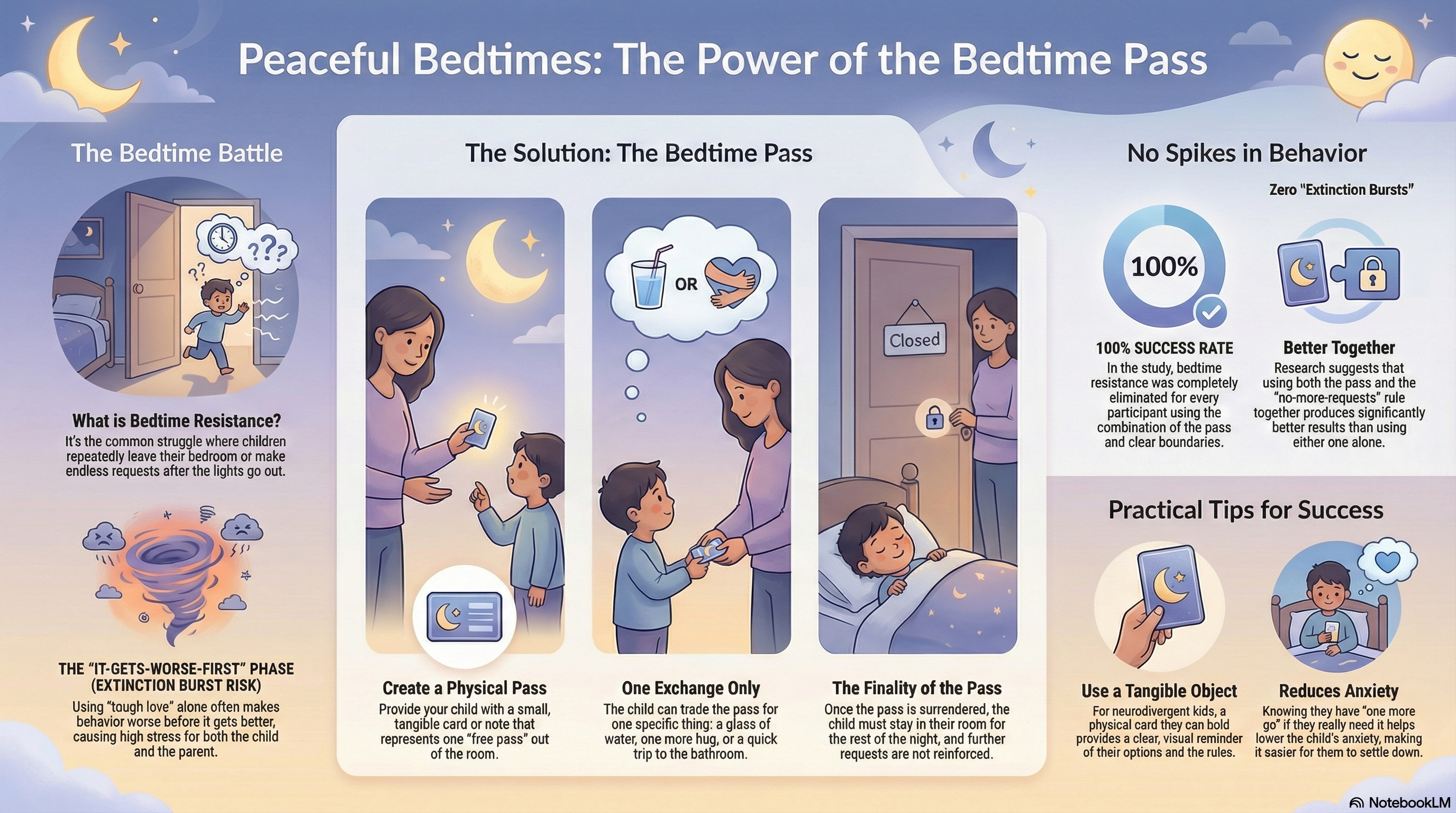
Bedtime can often feel like trying to drop anchor in the middle of a gale. Researchers looked at how three-year-olds handled the transition to sleep and found that a simple, physical tool called a “Bedtime Pass” made a massive difference. By giving the child a card they could trade in for one—and only one—trip out of the room for a specific reason (like a glass of water or one last hug), the nightly stalling and protests significantly dropped.
What’s particularly helpful for our families is that this method avoided the “extinction burst”—that intense spike in crying or shouting that often happens when we suddenly stop responding to bedtime requests. Instead of the situation getting much worse before it got better, the pass acted as a safety valve, allowing the child to transition into the night without a total loss of control.
Why This Matters for Your Family
For those of us navigating neurodivergent waters, bedtime isn’t just a schedule; it’s a high-stakes transition. Our kids often crave a sense of agency, and a flat “no” can easily trigger a fight-or-flight response. The Bedtime Pass works because it offers a tiny bit of autonomy. It lets your child feel like they have some say over their environment, which can lower their anxiety enough to let sleep take over.
This is also a gift for the co-parenting relationship. When we’re exhausted at the end of the day, it’s easy for one parent to be the “strict captain” and the other to be the “soft harbor,” which leads to confusion for the child and friction between parents. Having a physical object—the pass—creates a shared boundary that everyone can stick to. It takes the heat out of the moment because the pass, not the parent, is the one holding the limit.
What You Can Do Today
- Create a physical pass together. Find a piece of cardstock or a heavy coaster and let your child decorate it. Making it a “real” object helps them understand the trade-off: once the pass is handed over, the “port” is closed for the night.
- Define the “Pass Rules” during the day. Sit down when things are calm and decide exactly what the pass can be used for—one drink, one bathroom trip, or one specific hug. Setting these “coordinates” in advance prevents exhausted mid-night negotiations.
- Hold the line with quiet empathy. When they use the pass, keep the interaction brief and low-energy. If they try for a second trip, you can gently remind them that the pass has been spent, acknowledging that staying in bed is a tough skill they are still learning.
The Original Paper
Freeman, K. A. (2006). Treating bed time resistance with the bed time pass: a systematic replication and component analysis with 3-year-olds. Journal of Applied Behavior Analysis.
Safety Note: This research summary is for informational purposes only and does not constitute medical or therapeutic advice. Always consult qualified professionals for your family’s specific situation. If you or your child are in crisis, contact your local emergency services or one of these helplines: 988 Suicide & Crisis Lifeline (US) | Lifeline Australia: 13 11 14 | Samaritans UK: 116 123 | Need to Talk? NZ: 1737
Research Brief
Generated by NotebookLM from the original paper. Not a replacement for the peer-reviewed source.
Read Full Brief →