Stormy Seas - Meltdowns Tantrums And Emotional Dysregulation
Preview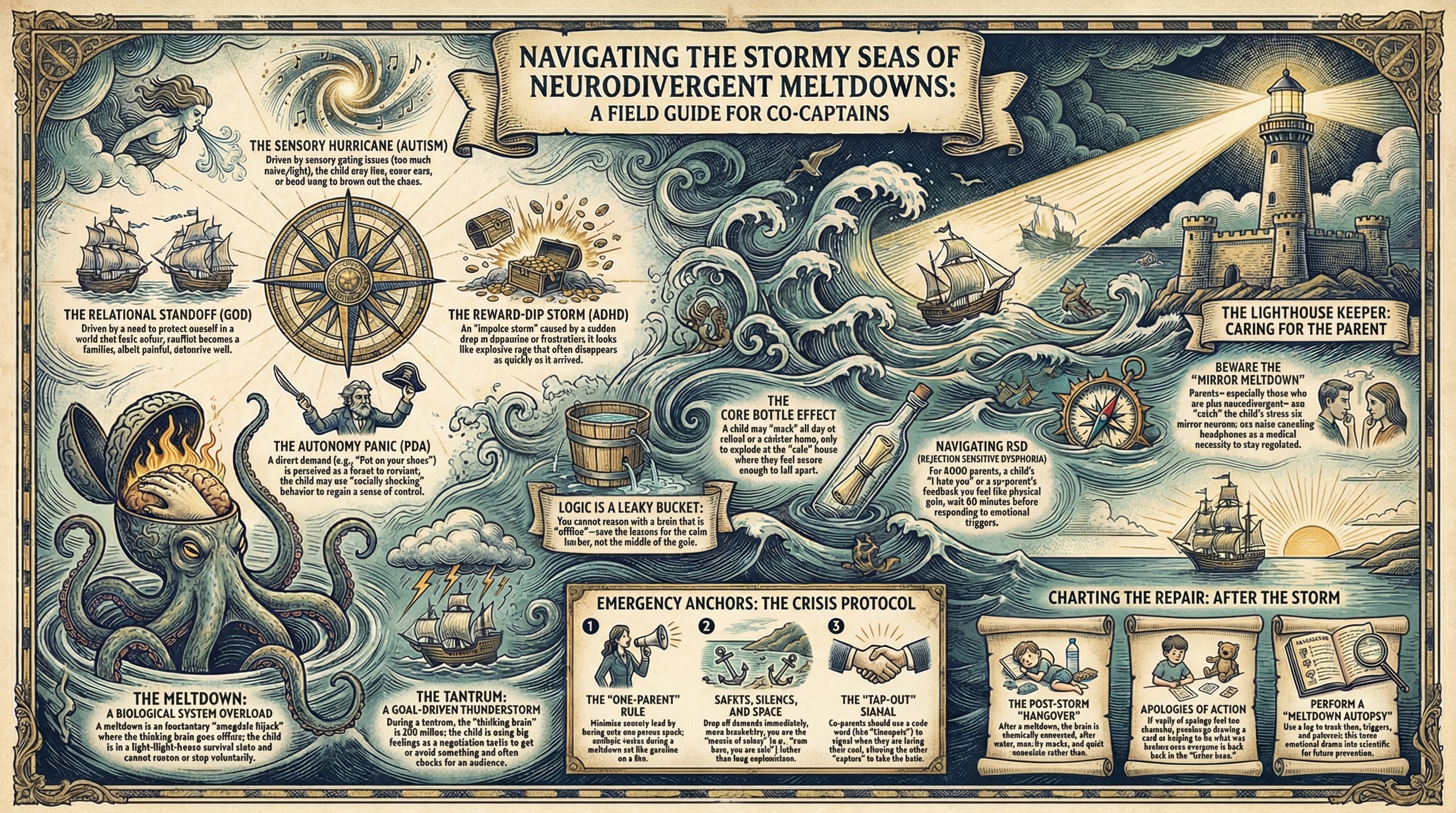

Quick Map: If you only read one page, read this
- The Difference: A tantrum is a negotiation tactic; a meltdown is a biological power surge.
- The Four Winds: Identify if the storm is Sensory (ASD), Dopamine (ADHD), Autonomy (PDA), or Relational (ODD).
- The Anchor: You may not be able to calm the storm, but you can be the steady ground. Co-regulation starts with your nervous system.
- The Protocol: In a meltdown, logic is offline. Use safety, silence, and space—not words.
- The Repair: Recovery takes time. Connect first, correct later.
Field Guide: Meltdowns vs Tantrums
What's happening in the brain/body: A tantrum is goal-driven—the child's prefrontal cortex (thinking brain) is partially online, monitoring if the strategy is working.
A meltdown is an involuntary nervous system overload—an "amygdala hijack" where the thinking brain goes offline. The amygdala (threat detection) triggers fight-flight-freeze, flooding the body with cortisol and adrenaline.
The child cannot reason, comply, or self-soothe in that moment. Different neurotypes have different triggers: ASD meltdowns often stem from sensory overload (too much input), ADHD from impulse surges (reward-regulation + weak brakes), PDA from perceived threats to autonomy (demands feel like danger), and ODD from relational friction (conflict as defence mechanism).
What it looks like at home: Tantrum: Child watches for your reaction, may negotiate ("fine, I'll stop if..."), recovers quickly when goal is met/abandoned.
Meltdown: Child is unreachable, doesn't respond to getting what she wanted, may hurt self/others without awareness, exhausted/remorseful afterward.
ASD: hands over ears, fleeing, self-injury. ADHD: explosive rage that dissipates fast ("I hate you" then asking for a snack). PDA: shocking behaviour to derail demands (going limp, stripping). ODD: arguing, vindictiveness.
What helps:
- Identify the type first (goal-driven or overload-driven)
- For meltdowns: Safety, silence, space. Be the calm anchor. Co-regulate with your own slow breathing.
- For tantrums: Hold the boundary, ignore the volume, offer choices when calm
- Reduce sensory load (dim lights, reduce talking, remove audience)
- Repair afterward when everyone is regulated (hours later, not immediately)
What backfires:
- Trying to reason during a meltdown ("Why are you acting this way?")
- Adding more demands or time pressure ("We need to leave NOW!")
- Treating meltdowns like manipulation ("You're doing this to get out of school")
- Punishing involuntary nervous system responses
One sentence to remember: "Tantrum = negotiation (brain partially online); Meltdown = biological crisis (brain offline)—respond with boundaries for the first, compassion for the second."
Navigating the roughest waters of the neurodivergent parenting voyage, where the squalls of emotion threaten to derail the course, and finding the beacon of co-regulation.
The voyage of raising a neurodivergent child is rarely a calm passage across a glassy bay. It is an open-ocean journey, subject to sudden squalls, rolling swells, and occasionally, terrifying hurricanes that seem to materialise from clear skies.
For co-parents of children with Attention Deficit Hyperactivity Disorder (ADHD), Autism Spectrum Disorder (ASD), Pathological Demand Avoidance (PDA), or Oppositional Defiant Disorder (ODD), these storm fronts represent the most visceral and exhausting challenge of the voyage.
These are the moments of screaming in the supermarket, the holes punched in walls, the refusal to leave the house that lasts for three hours, and the heartbreaking sobs of a child who feels entirely out of control.
In the charts of this family experience, the waters of emotional dysregulation are often marked with warning signs: "Here Be Monsters." Yet, the monsters are not the children.
The monsters are the misunderstood neurological firings, the sensory overloads, the anxiety spikes, and the impulsive surges that hijack the child’s brain. When co-parents view these squalls through the lens of "bad behaviour" requiring stricter discipline, the voyage takes on heavy burdens.
The team turns on each other, blaming the other co-captain for the rough weather. However, when parents view these events through the lens of neuroscience and compassion—understanding the squall as a physiological event rather than a personal attack—they can weather the gale together, keeping the team intact and the passengers safe.
This chapter serves as a comprehensive manual for navigating these storm fronts. It distinguishes the neurological meltdown from the behavioural tantrum, provides emergency protocols for the heat of the moment, and offers a framework for repair and prevention.
Crucially, it addresses how two co-captains—whether sharing a lead or navigating separate routes—can align their strategies to prevent the team from being lost in the turmoil.
Continue Reading
Unlock the full content including Tactical Strategies, Parent Toolkit, and Survival Card.
Get Full AccessPay what you can - from $5