The Morning Passage - Routines And Rituals For A Smooth Start
Preview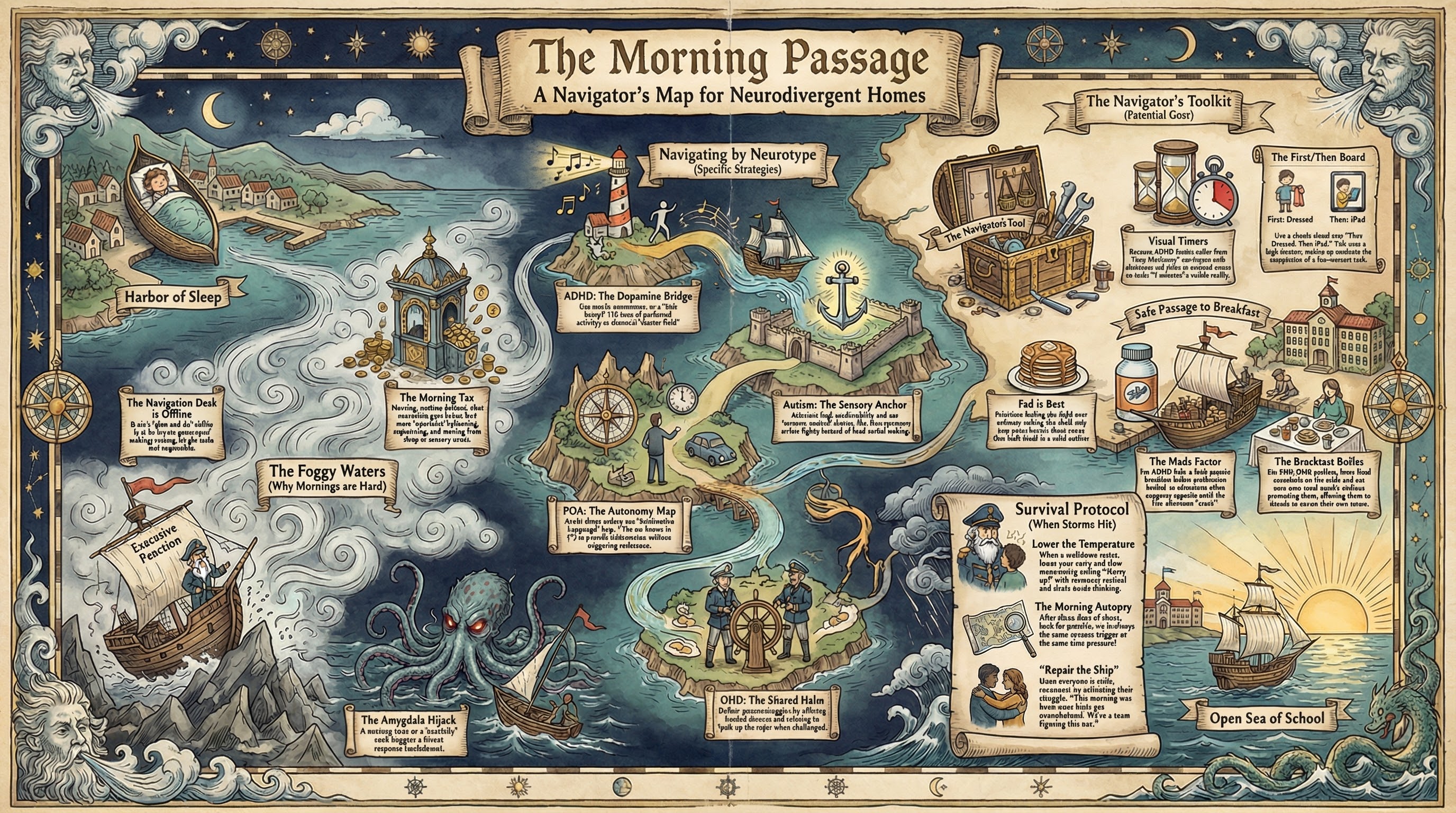

"We cannot direct the wind, but we can adjust our pace." — Adapted from Dolly Parton (and every co-parent trying to get a neurodivergent child out the door by 8:00 AM).
Quick Map: If you only read one page, read this
- The Morning Tax: Morning routines demand exactly what ND brains find most expensive—executive function (planning, sequencing) and state regulation (sensory transition from sleep to chaos).
- Neurotype Strategies: ADHD needs dopamine bridges (music, movement); ASD needs predictability (same routine, transition objects); PDA needs low-demand language ("The team leaves in 5" vs "Get in the car"); ODD needs control options ("Eggs or toast?").
- The Launch Pad: Create one designated zone near the front door where ALL exit items live (backpack, shoes, coat). For ADHD brains, "out of sight = doesn't exist"—consolidate visually.
- Evening Sets Up Morning: The chaotic morning starts the night before. Use sensory decompression after school, prep the next day during calm, and protect sleep as a biological necessity.
- Co-Parent Alignment: You don't need identical routines in both harbors, but you need functional consistency—agree on medication timing, the Launch Pad concept, and "Big Three" rules (safety, school, medical).
1. Introduction: Charting the Daily Passage
The alarm clock does not ring; it declares war. Or at least, that is how it feels when you are leading a voyage that hasn't even left the home port yet.
Imagine trying to launch a team into a thick fog. Half the members are resistant, your navigation tools are screaming conflicting data, and one person refuses to even put on her life vest because the straps feel wrong. Now imagine you have two co-captains—you and your co-parent—shouting instructions from different ports, or trying to hand off the supplies in the middle of a storm.
This is the Morning Passage.
For parents of children with ADHD, Autism, PDA, and ODD, the morning is the most scientifically complex segment of the day. It is a collision of biology, psychology, and logistics. It is the time when Executive Function (the ability to plan and do) is at its lowest, and stress (cortisol) is forced to its highest just to get out the door.
We didn't receive an instruction manual for these waters. So, we are drawing our own map.
This chapter is your navigational guide to the narrow channel between "Wake Up" and "School Drop-Off." We will explore the hidden reefs of sensory processing, the doldrums of dopamine deficits, and the sudden squalls of transition anxiety. We will equip you with a survival kit: Visual Schedules, Dopamine Bridges, Launch Pads, and Declarative Language.
Crucially, we will address the co-parenting dynamic. Whether you are leading this team together or passing the baton across households, these strategies are designed to build a unified course. We will explore "Anchor Routines" that provide safety for your child, ensuring that even if the harbors look different, the feeling of security remains the same.
Continue Reading
Unlock the full content including Tactical Strategies, Parent Toolkit, and Survival Card.
Get Full AccessPay what you can - from $5