Videoconferencing group parent training program for caregivers of children with ADHD: A preliminary study.
Dörttepe Zümra Ülker, Duman Zekiye Çetinkaya
What This Paper Found
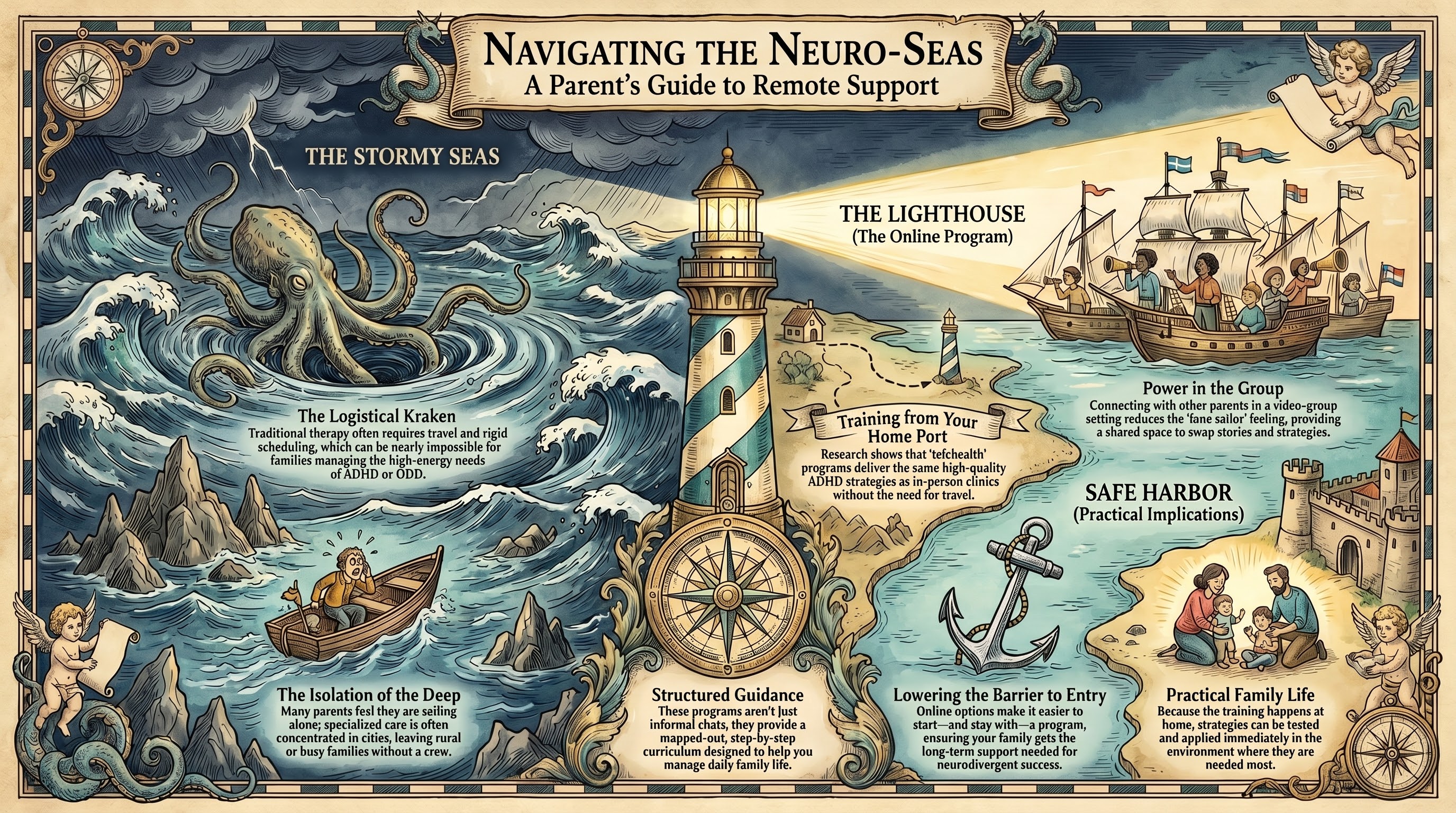
Researchers Dörttepe and Duman tested a new online group parent training program for families of kids with ADHD. Instead of asking parents to travel to a clinic, they ran structured video calls — small groups, trained facilitators, a curriculum built around the day-to-day friction of ADHD parenting.
The preliminary findings were encouraging: parents engaged with the format, the group dynamic appeared to provide real peer support, and the program looked feasible to deliver via telepsychiatry. It’s a small, early-stage study, so nobody’s claiming a breakthrough — but it suggests the video format isn’t just a pandemic workaround. It can actually work.
Think of it less as a lighthouse on a distant shore and more as a radio channel you can tune into from your own kitchen.
Why This Matters for Your Family
If you’ve ever tried to book an in-person parenting course while also juggling school pickup, work, and a dysregulated seven-year-old, you already know why this matters. Geography, scheduling, cost, transport — these aren’t minor inconveniences. They’re often the reason evidence-based parent training never reaches the families who’d benefit most.
Online group formats can collapse some of those barriers. You can join from the car park during a shift break. You can hear another parent describe the exact meltdown pattern you dealt with last Tuesday. That “it’s not just us” moment is often as valuable as the clinical content itself.
For co-parents — especially in separated or high-conflict households — the video format offers something quietly useful: you can attend the same session without being in the same room. Both captains getting the same briefing, without navigating the logistics of a shared waiting room. Even if only one of you attends, shared language and strategies across two homes can reduce the friction a child carries between them.
What You Can Do Today
- Ask your paediatrician or GP what’s available in your region. Telehealth parent training is growing quickly — programs like Triple P Online, Parent Management Training, and ADHD-specific group formats may be accessible through public health systems, private providers, or research trials. A five-minute phone call often surfaces options you didn’t know existed.
- If cost or access is a barrier, check the research pipeline. Studies like this one frequently recruit families and deliver the program free of charge. University psychology departments and children’s hospital clinics are good starting points.
- Share the approach with your co-parent if it’s safe to do so. Even forwarding one session summary or one handout keeps you both working from the same chart. When parallel parenting, shared information is often more achievable than shared attendance — and still useful.
The Original Paper
Dörttepe, Z. Ü., & Duman, Z. Ç. (2026). Videoconferencing group parent training program for caregivers of children with ADHD: A preliminary study. Archives of Psychiatric Nursing, 60, 152001. https://doi.org/10.1016/j.apnu.2025.152001
Safety Note: This research summary is for informational purposes only and does not constitute medical or therapeutic advice. Always consult qualified professionals for your family’s specific situation. If you or your child are in crisis, contact your local emergency services or one of these helplines: 988 Suicide & Crisis Lifeline (US) | Lifeline Australia: 13 11 14 | Samaritans UK: 116 123 | Need to Talk? NZ: 1737
Research Brief
Generated by NotebookLM from the original paper. Not a replacement for the peer-reviewed source.
Read Full Brief →