Cognitive and emotional profiles in children with ASD, ADHD, and comorbid presentations: evidence for a distinct clinical phenotype.
Narzisi Antonio, Barbetti Federica, Fabbri-Destro Maddalena, Berloffa Stefano, Fantozzi Pamela, Viglione Valentina, Muccio Rosy, Valente Elena, Accorinti Ilaria, Foti Elisa, Milone Annarita, Cardillo Ramona, Masi Gabriele
What This Paper Found
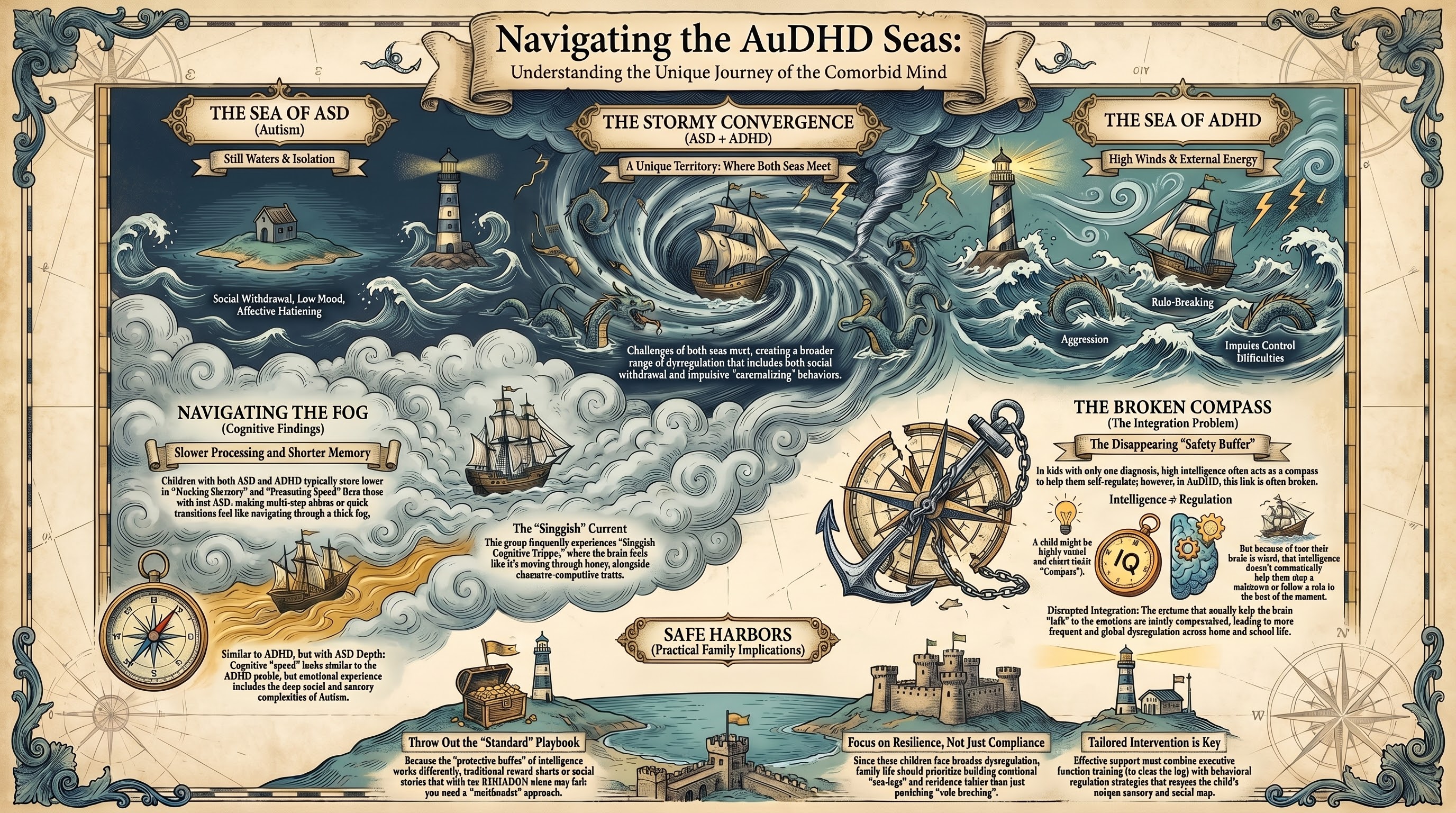
Researchers at multiple Italian clinical centres compared three groups of kids: those with autism alone, those with ADHD alone, and those carrying both diagnoses. What they found is something a lot of dual-diagnosis families have been quietly suspecting for years — the combination isn’t just “autism plus ADHD.” It’s its own thing.
Kids with both conditions tended to struggle more with working memory (holding instructions in their head long enough to act on them) and processing speed (how quickly they can take in and respond to information) than kids with autism alone. They also showed a wider range of emotional and behavioural challenges — more anxiety and withdrawal AND more outward stuff like aggression or rule-breaking. The internalising and externalising weren’t either/or. They were both/and.
Maybe most importantly: the cognitive strengths that often act as a buffer for kids with a single diagnosis (a strong vocabulary, good pattern recognition) didn’t do the same protective work when both conditions were in play. Two different storms don’t just add up — they interact.
Why This Matters for Your Family
If you’ve ever sat in a meeting where someone confidently prescribed “what works for autism” or “what works for ADHD” and walked out feeling like they were describing a different kid than yours — this paper is the closest thing to validation research can offer. Strategies built around a single diagnosis often don’t land the same way for AuDHD kids, and now there’s data confirming that’s not parental imagination or implementation failure.
For daily life, this means supports that look reasonable on paper (a visual schedule, a fidget tool, a social story) might still leave your child swamped if the underlying working memory and processing speed demands are too high. The emotional weather can also shift fast — withdrawal one hour, explosion the next — without one being a “better” sign than the other. Both are signals the load is too heavy.
For co-parents, this is worth raising explicitly: if one of you is anchored to the autism playbook and the other to the ADHD playbook, you’re both probably half-right and half-missing the kid in front of you. The research suggests building a third playbook — one that assumes the protective factors from either condition alone won’t carry the day, and that planning has to start from a position of “this will be harder than either checklist suggests.”
What You Can Do Today
- Lower the working memory load before you do anything else. When a request isn’t landing, don’t repeat it louder — strip it down. One step at a time, written or pictured wherever possible. Save the verbal instructions for when the nervous system has the bandwidth.
- Treat withdrawal and explosion as the same signal. Both mean “too much.” If your kid goes quiet and disappears into their room, that deserves the same gentle response you’d give a meltdown — not relief that “at least they’re not having a tantrum.”
- Write down what helps in each direction with your co-parent. Make two short lists: “things that help when they’re shutting down” and “things that help when they’re blowing up.” Share both lists across both households. The strategies won’t always match — and that’s the point.
The Original Paper
Narzisi, A., Barbetti, F., Fabbri-Destro, M., Berloffa, S., Fantozzi, P., Viglione, V., Muccio, R., Valente, E., Accorinti, I., Foti, E., Milone, A., Cardillo, R., & Masi, G. (2026). Cognitive and emotional profiles in children with ASD, ADHD, and comorbid presentations: evidence for a distinct clinical phenotype. Frontiers in Psychiatry, 17, 1765698. https://doi.org/10.3389/fpsyt.2026.1765698
Safety Note: This research summary is for informational purposes only and does not constitute medical or therapeutic advice. Always consult qualified professionals for your family’s specific situation. If you or your child are in crisis, contact your local emergency services or one of these helplines: 988 Suicide & Crisis Lifeline (US) | Lifeline Australia: 13 11 14 | Samaritans UK: 116 123 | Need to Talk? NZ: 1737
Research Brief
Generated by NotebookLM from the original paper. Not a replacement for the peer-reviewed source.
Read Full Brief →