Broader autism phenotype in parents of children with autism: a systematic review of percentage estimates
Rubenstein Eric, Chawla Devika
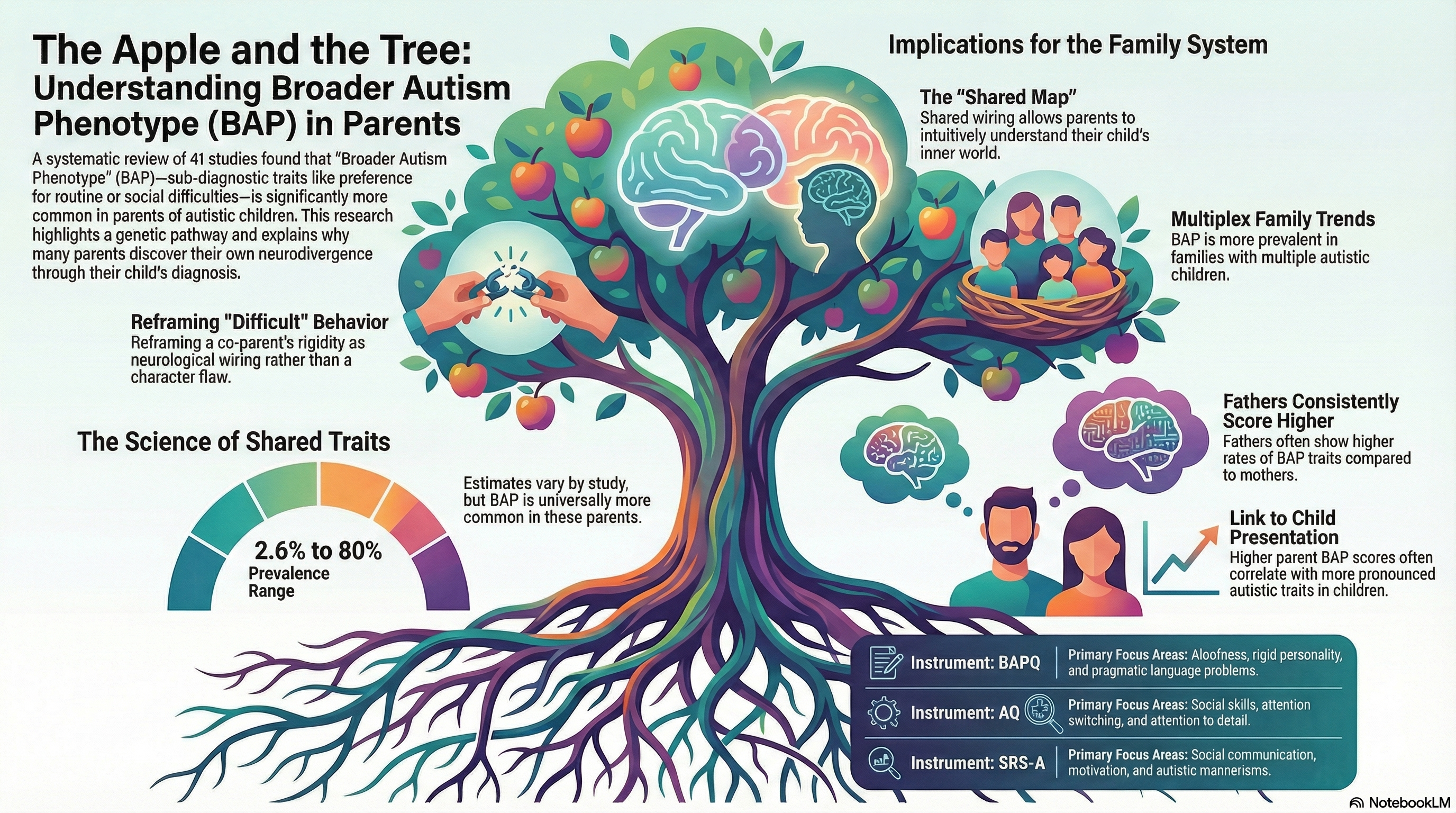
What This Paper Found
If you have ever sat through your child’s autism assessment and thought, “Wait — that sounds like me,” you are not imagining things. This systematic review by Rubenstein and Chawla examined 41 studies measuring the “broader autism phenotype” (BAP) in parents of autistic children. The BAP refers to sub-diagnostic autistic traits — things like a preference for routine, difficulty reading social cues, intense focus on specific interests, or a communication style that others find blunt — that don’t meet the threshold for an autism diagnosis but are clearly part of the same neurological landscape.
The findings are striking. Across 41 studies using eight different assessment instruments and sample sizes ranging from 4 to 3,299, the prevalence of BAP traits in parents of autistic children ranged from 2.6% to 80%. Fathers consistently showed higher rates than mothers (2.6%–80% vs 3%–52%), though this pattern was not universal. Critically, the review found positive associations between parent BAP scores and child autism severity — suggesting that when a parent carries more of these traits, their child’s presentation tends to be more pronounced.
Why This Matters for Your Family
Chapter 10 of this book is built around a moment many parents describe as the most disorienting of their lives: discovering their own neurodivergence through their child’s diagnosis. This research helps explain why that moment happens so often. It is not a coincidence or confirmation bias. There is a measurable, documented genetic pathway from parent traits to child traits.
For co-parents, this has profound implications. When one parent recognises their own BAP traits, it can transform the co-parenting dynamic in two directions. In the best case, it creates what the similarity-fit research calls a “shared map” — an intuitive understanding of the child’s inner world that the other parent may not have. In the more challenging case, it means one parent is navigating their own undiagnosed executive function difficulties, sensory sensitivities, or social exhaustion while simultaneously trying to coordinate care across two homes.
The review also highlights a finding that matters for separated families: fathers showed higher BAP rates overall. In many co-parenting arrangements, the father who seems “rigid” or “difficult to communicate with” may not be choosing to be obstinate — he may be operating from the same neurological wiring as the child. This does not excuse harmful behaviour, but it does reframe the conversation from “he won’t cooperate” to “he may genuinely process this differently.”
What You Can Do Today
- Take a quiet inventory of your own traits. Not to diagnose yourself, but to notice: do you share your child’s need for predictability? Their sensory sensitivities? Their intense focus? Recognising shared wiring is the first step toward using it as a co-parenting strength rather than a source of conflict.
- Reframe your co-parent’s “difficult” traits through a BAP lens. If your co-parent is rigid about routines, literal in communication, or overwhelmed by social demands, consider whether these might be neurological traits rather than character flaws. This does not mean accepting poor behaviour — it means understanding the operating system behind it.
- Seek your own assessment if the shoe fits. A growing number of Australian adults are pursuing late-life ADHD and autism assessments through Medicare Mental Health Care Plans. If your child’s diagnosis felt like looking in a mirror, a formal assessment can open doors to support you did not know existed.
The Original Paper
Rubenstein, E., & Chawla, D. (2018). Broader autism phenotype in parents of children with autism: a systematic review of percentage estimates. Journal of Child and Family Studies, 27(6), 1705–1720. https://doi.org/10.1007/s10826-018-1026-3
This post is part of our weekly research series, where we break down peer-reviewed studies into practical guidance for co-parents of neurodivergent children. The Australian edition of “This Wasn’t in the Brochure” is available at thiswasntinthebrochure.wtf.
Research Brief
Generated by NotebookLM from the original paper. Not a replacement for the peer-reviewed source.
Read Full Brief →