Genetic Testing Found Answers for Nearly Half of 1,052 Children with Unexplained Intellectual Disability
Pan, X., Qian, G., Liu, L., Zhang, X., Yang, Y., Zhang, Q., Tang, X., Yang, N., Dong, L., Yao, H., Dong, X., & Tan, B.
What This Paper Found
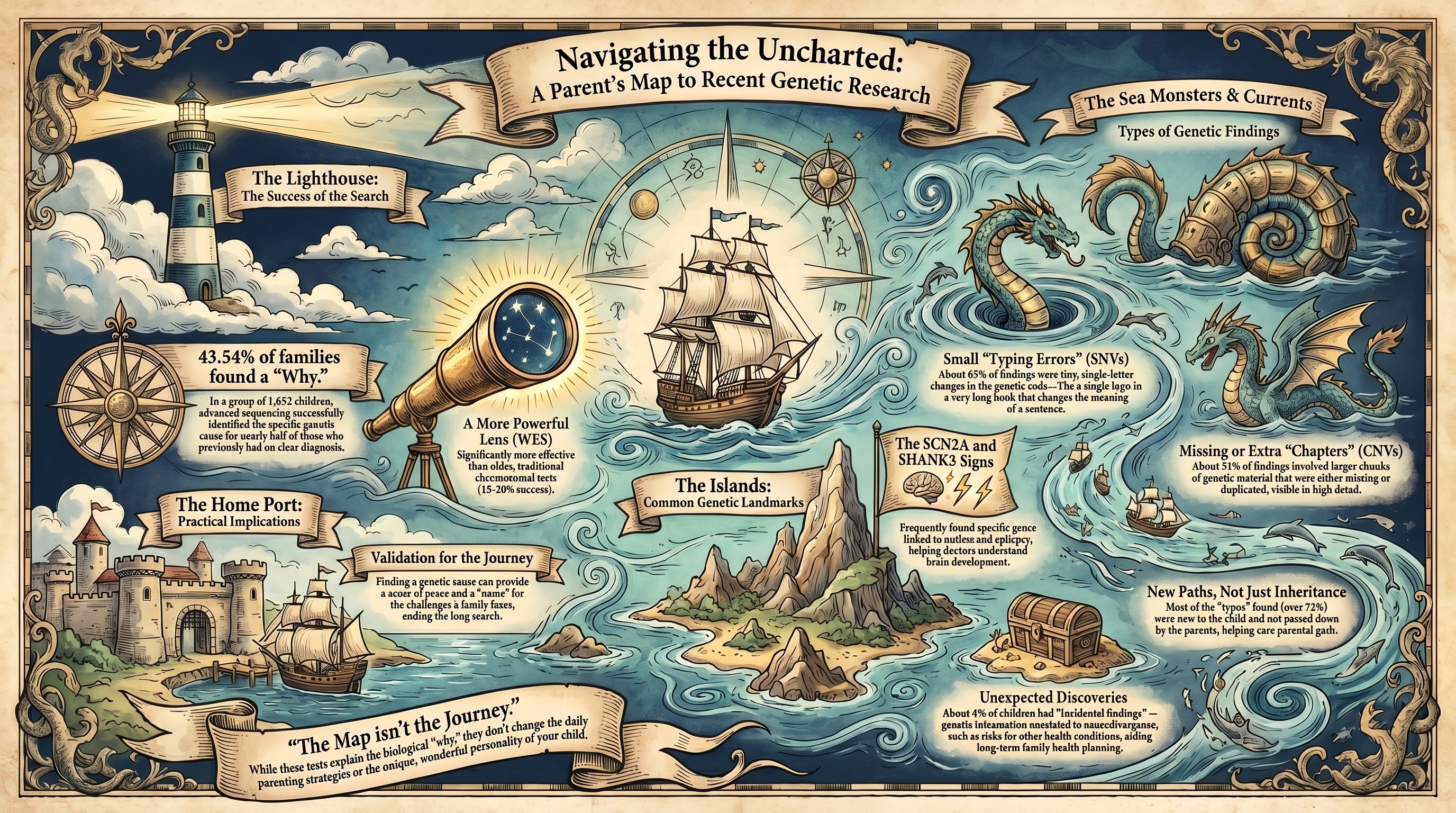
Researchers ran whole-exome sequencing (WES) — a type of genetic test that reads nearly all protein-coding genes — on 1,052 children with intellectual disability that hadn’t been explained by standard testing. They found a definitive genetic answer in 43.5% of cases. That’s nearly half.
The most commonly affected genes read like a who’s-who of neurodevelopmental conditions. SCN2A (linked to epilepsy and autism). SHANK3 (mutated in about 2% of autistic people with co-occurring intellectual disability). KDM5C (a well-known X-linked intellectual disability gene). The study also picked up structural variations — larger chunks of missing or duplicated DNA — that standard gene-by-gene testing would have missed entirely.
Perhaps most striking: 4% of families received incidental findings unrelated to the child’s disability — things like hereditary cancer risk genes that the family didn’t know about.
Why This Matters for Your Family
If you’ve been on the diagnostic odyssey — that exhausting, years-long voyage through specialists, tests, and “we’re not sure” — this study quantifies something important: genetic testing has a real chance of providing answers.
A 43% diagnostic yield doesn’t mean the other 57% are out of luck. It means the technology is catching up to the complexity. And for the families who do get an answer, the impact can be profound. Not because a diagnosis changes the child — your kid is the same person either way — but because it can:
- End the search (and the emotional toll that comes with it)
- Connect you with other families navigating the same condition
- Unlock condition-specific supports and research trials
- Give both co-parents a shared understanding of what they’re working with
That last point matters more than clinicians sometimes realise. When there’s no clear diagnosis, it’s easy for co-parents to fall into the blame trap — “it’s because of the screen time” or “it’s because of the divorce.” A genetic finding doesn’t erase those conversations, but it reframes them. This is neurology, not parenting.
What You Can Do Today
- Ask your child’s paediatrician or geneticist about whole-exome sequencing if standard testing hasn’t provided answers. It’s increasingly covered by insurance/public health systems for children with unexplained developmental delays.
- Keep a record of your child’s developmental history — when milestones were reached, what patterns you’ve noticed. This context helps geneticists interpret results.
- If you receive results, request a genetic counselling session for both co-parents together (or separately if needed). Understanding what the findings mean — and don’t mean — is critical.
The Original Paper
Pan, X., Qian, G., Liu, L., Zhang, X., Yang, Y., Zhang, Q., Tang, X., Yang, N., Dong, L., Yao, H., Dong, X., & Tan, B. (2026). Genetic analysis and reporting from whole-exome sequencing data in 1052 patients with intellectual disability. Journal of Medical Genetics.
Safety Note: This research summary is for informational purposes only and does not constitute medical or therapeutic advice. Always consult qualified professionals for your family’s specific situation. If you or your child are in crisis, contact your local emergency services or the 988 Suicide & Crisis Lifeline.