Comparing eating and mealtime experiences in families of children with autism, attention deficit hyperactivity disorder and dual diagnosis.
Matthews Zoe, Pigden-Bennett Donna, Tavassoli Teresa, Snuggs Sarah
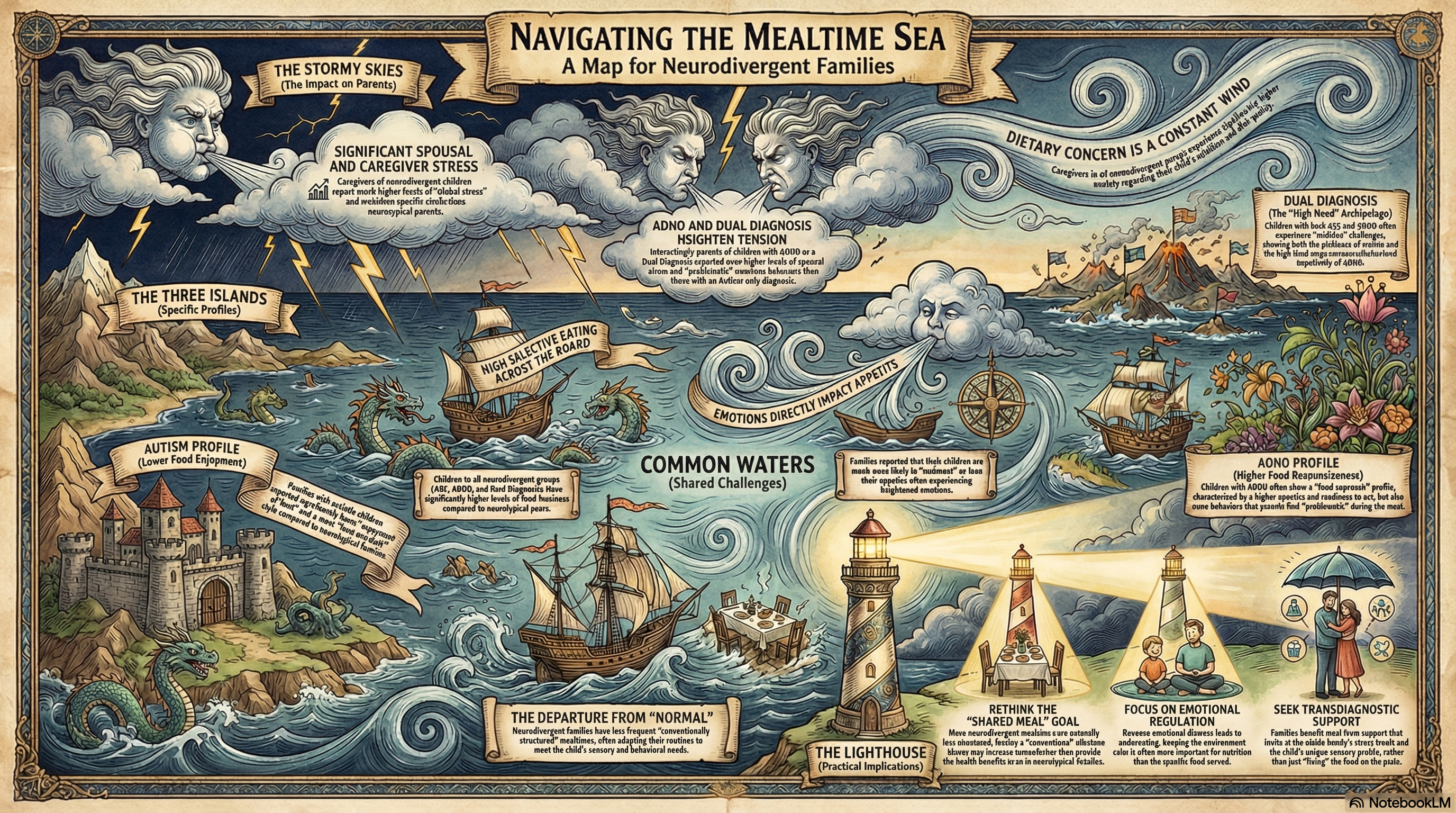
What This Paper Found
Researchers recently looked at how families with autistic children, children with ADHD, and those with a dual diagnosis (AuDHD) navigate the daily “passage” of mealtimes. They found that for our families, the standard “dinner at the table” map often doesn’t fit. Neurodivergent children frequently experience more food fussiness, less enjoyment of eating, and more intense behaviors that can make sitting down for a meal feel like steering through a gale.
The study highlighted that families with both ADHD and autism often face the most turbulent waters, reporting the highest levels of stress for both caregivers and their partners. While ADHD was more linked to impulsive eating and mealtime disruptions, autism tended to involve less interest in food itself. Crucially, the research confirms that it is completely normal for our households to have less structured mealtimes than neurotypical ones; we are simply sailing in different conditions.
Why This Matters for Your Family
If your family meals feel less like a peaceful harbor and more like a search-and-rescue mission, this research offers a much-needed lighthouse. It validates that the stress you and your co-parent feel isn’t a sign of a “failed” routine—it’s a reflection of the very real support needs required when a child’s brain processes sensory input and impulse control differently. Understanding that these challenges are part of the neurodivergent “current” can help lower the temperature at the table.
Recognizing these patterns also helps us adjust our expectations of one another. When we see that ADHD might bring impulsivity and autism might bring sensory avoidance, we can stop blaming ourselves for the lack of a “conventional” dinner. For co-parents, this is a reminder that the stress is shared; when one captain is struggling at the helm during a difficult meal, the other is likely feeling the spray too. Validating each other’s exhaustion is often the first step toward a calmer voyage.
What You Can Do Today
- Adjust your chart for “success.” If a formal sit-down meal causes a storm every night, give yourself permission to drop the traditional structure. A “picnic” on the living room floor or staggered eating times might be the calmer passage your family needs right now.
- Audit the sensory environment. Look at your mealtime through a sensory lens—is the lighting too bright, the chair uncomfortable, or the clinking of cutlery too loud? Small changes to the “conditions on deck” can significantly lower the friction for a child who finds the sensory experience of eating overwhelming.
- Hold a co-captain debrief. Sit down with your partner away from the table to acknowledge how stressful mealtimes have been. Instead of focusing only on “fixing” the child’s behavior, discuss how you can support each other to stay regulated when the waters get choppy.
The Original Paper
Matthews, Z., Pigden-Bennett, D., Tavassoli, T., & Snuggs, S. (2024). Comparing eating and mealtime experiences in families of children with autism, attention deficit hyperactivity disorder and dual diagnosis.
Safety Note: This research summary is for informational purposes only and does not constitute medical or therapeutic advice. Always consult qualified professionals for your family’s specific situation. If you or your child are in crisis, contact your local emergency services or the 988 Suicide & Crisis Lifeline.
Research Brief
Generated by NotebookLM from the original paper. Not a replacement for the peer-reviewed source.
Read Full Brief →