'I live in extremes': A qualitative investigation of Autistic adults' experiences of inertial rest and motion.
Rapaport Hannah, Clapham Hayley, Adams Jon, Lawson Wenn, Porayska-Pomsta Kaśka, Pellicano Elizabeth
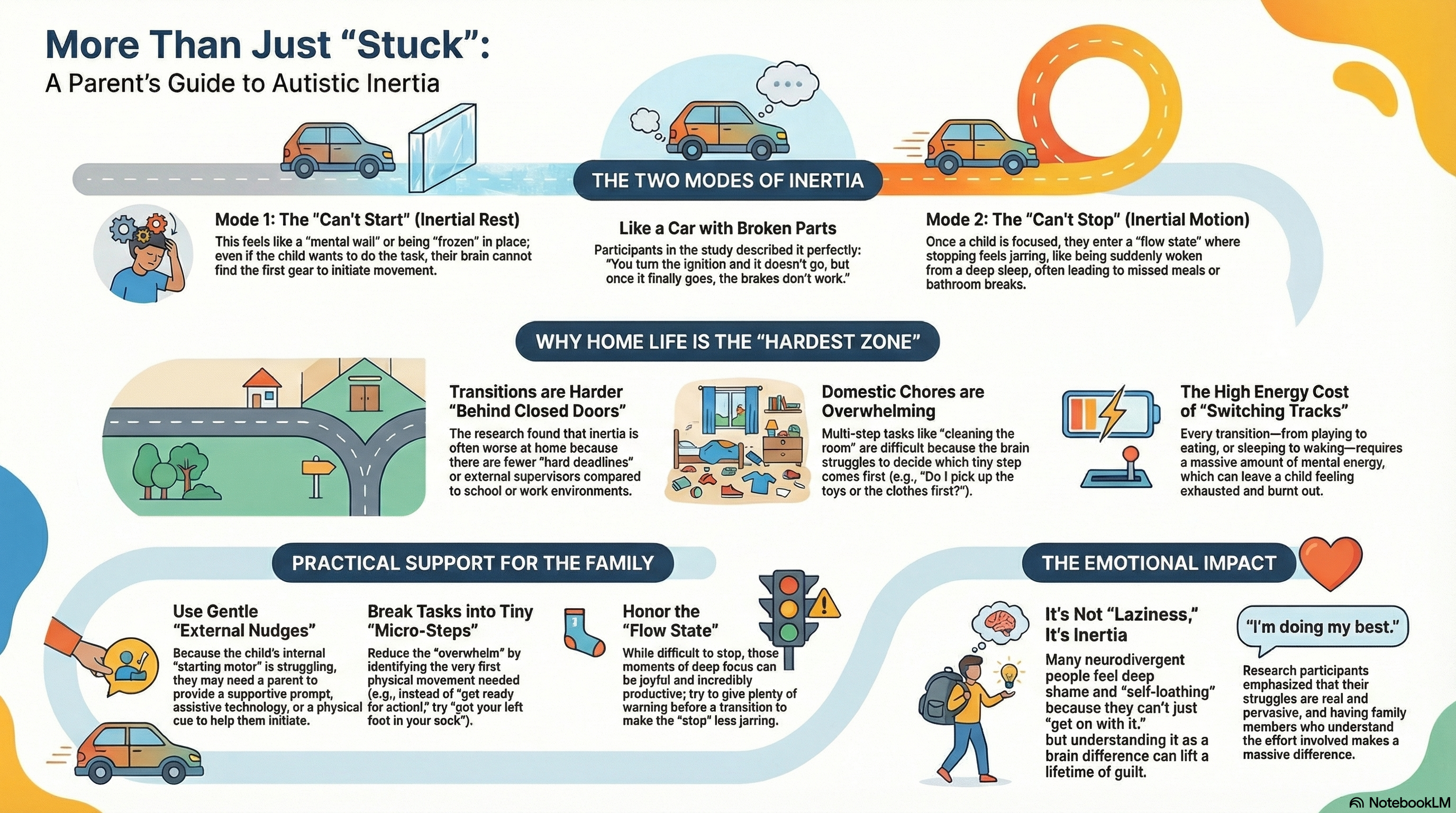
What This Paper Found
Researchers sat down with 24 autistic adults to talk about something many of us see every day but struggle to name: autistic inertia. It’s that intense “stickiness” when trying to start or stop a task. For many in the study, this wasn’t just a minor inconvenience; they described it as one of the most disabling parts of their daily lives, affecting how they move through the world every single day.
But the findings weren’t all stormy seas. While inertia makes it incredibly hard to lift the anchor and get moving, or to stop once you’re at full sail, it also has a bright side. The same neurological momentum that makes transitions difficult also allows for deep, joyful immersion in a task. When your child is completely lost in their interests, they aren’t just “busy”—they are experiencing a powerful and enabling state of flow.
Why This Matters for Your Family
If you’ve ever felt like your morning routine is a constant battle against an invisible tide, this research offers some much-needed validation. It confirms that the difficulty your child (or perhaps your co-parent) has with changing course isn’t about “won’t”—it’s about “can’t” in that moment. It’s a neurological reality, not a lack of motivation or a sign of “naughty” behavior.
For co-parents, understanding inertia can be the compass that helps you navigate high-stress transitions together. Instead of one parent feeling like the “enforcer” while the other feels like the “pushover,” you can both recognize that the brain simply needs more time to transition between states. Viewing these moments through the lens of inertia allows you to replace frustration with a shared strategy for smoother daily passages.
What You Can Do Today
- Label the “stickiness” without judgment. When you see your child struggling to start their homework or stop playing a game, remind yourself that their brain is experiencing inertia. Simply naming it as a neurological “stuckness” can help you stay calm and empathetic in the moment.
- Protect the flow states when possible. If your child is deeply immersed in a project and there’s no urgent need to move on, try to let them stay in that current for a little longer. That deep focus is often where autistic people find their greatest sense of joy and competence.
- Build in “buffer zones” for transitions. Since we know it is physically difficult for them to stop a task, give plenty of lead time before a change. Use visual timers or “five-minute warnings” to help them slowly prepare to lift the anchor before the actual transition needs to happen.
The Original Paper
Rapaport, H., Clapham, H., Adams, J., Lawson, W., Porayska-Pomsta, K., & Pellicano, E. (2023). ‘I live in extremes’: A qualitative investigation of Autistic adults’ experiences of inertial rest and motion. Autism.
Safety Note: This research summary is for informational purposes only and does not constitute medical or therapeutic advice. Always consult qualified professionals for your family’s specific situation. If you or your child are in crisis, contact your local emergency services or one of these helplines: 988 Suicide & Crisis Lifeline (US) | Lifeline Australia: 13 11 14 | Samaritans UK: 116 123 | Need to Talk? NZ: 1737
Research Brief
Generated by NotebookLM from the original paper. Not a replacement for the peer-reviewed source.
Read Full Brief →