Growing Brains, Nurturing Minds-Neuroscience as an Educational Tool to Support Students' Development as Life-Long Learners.
Goldberg Hagar
What This Paper Found
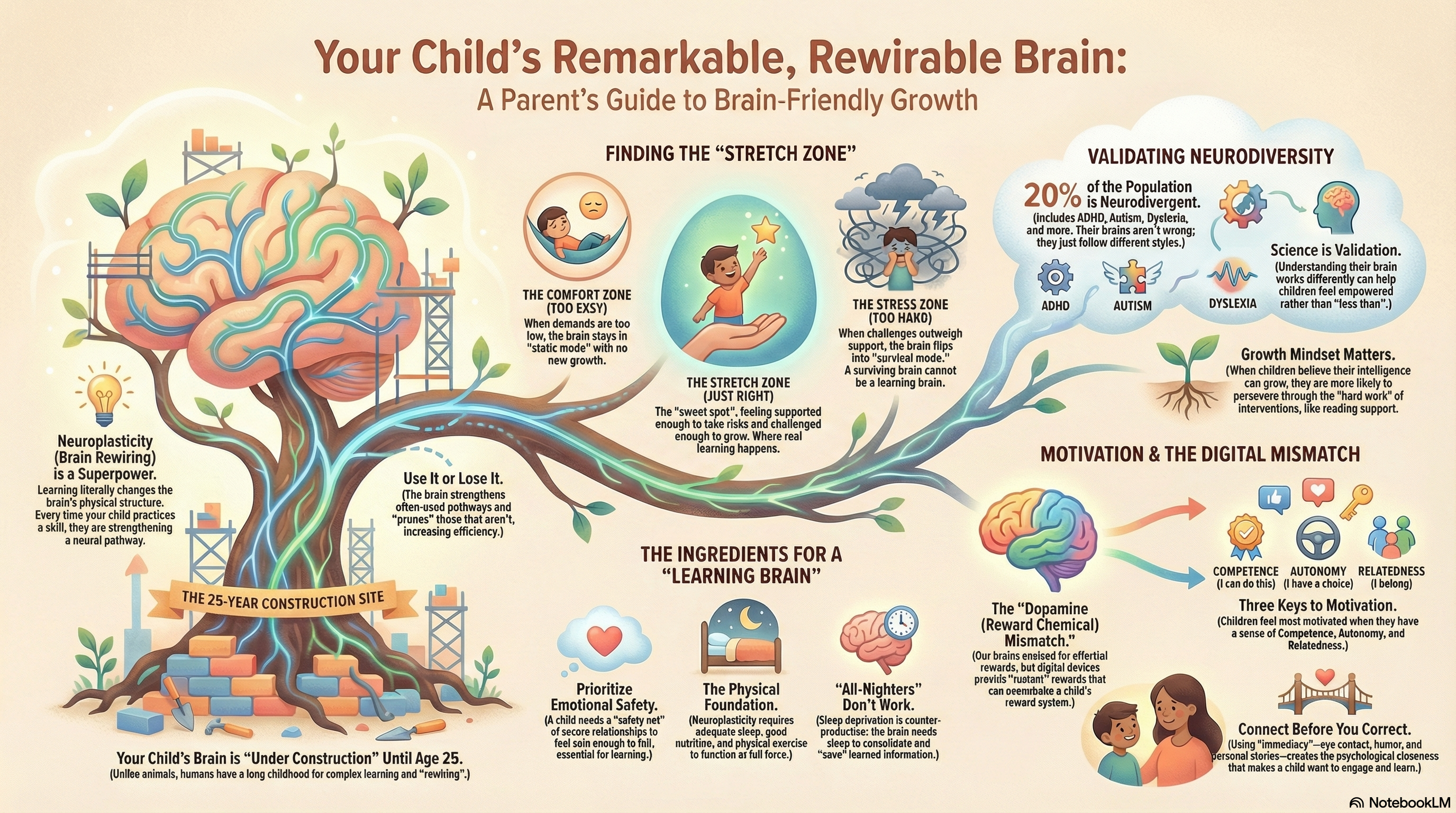
Researchers have highlighted something we often forget in the heat of a difficult morning: the human brain is an incredibly slow-burn project. Unlike many other species that are ready to go shortly after birth, our children’s brains remain a “construction site” for the first two and a half decades of life. This isn’t a design flaw; it’s a biological strategy. This extended childhood provides a massive window for neuroplasticity, where every experience helps shape the neural pathways your child will use for the rest of their lives.
The study emphasizes that learning isn’t just about memorizing facts; it is the actual physical process of building the brain. Because this maturation takes until the mid-twenties, there is a constant, evolving opportunity for growth and adaptation. The research suggests that when children understand how their own brains actually work—the “neuroscience of learning”—they often feel more empowered and motivated. It’s less like following a rigid chart and more like learning to read the shifting currents of their own minds.
Why This Matters for Your Family
For those of us co-parenting neurodivergent kids, this 25-year timeline is a vital dose of perspective. When you’re dealing with the intense stormy seas of ADHD, Autism, or PDA, it can feel like you’re running out of time to “get it right.” This research reminds us that we aren’t looking for a quick fix; we are supporting a long-term build. Your child isn’t “broken” or “lazy”; they are simply in a prolonged state of development that requires a specific kind of architectural support.
This also changes the conversation between co-parents. Instead of arguing over why a child hasn’t “mastered” a skill yet, we can align as two captains recognizing that the ship is still being built while at sea. When both parents understand that the environment—not just the child’s “willpower”—shapes the brain, it reduces the blame game. We can move away from frustration and toward asking how we can make our home more “brain-friendly” for the construction work currently happening.
What You Can Do Today
- Demystify the “Construction Site” for your child. Explain to them that their brain is still building its “control center” and won’t be fully finished until they are 25. This can reduce their shame when they struggle with big emotions, reframing a difficult moment as a temporary construction delay rather than a character flaw.
- Audit your environment for “brain-friction.” Look at one daily routine—like the morning passage out the door—and identify one sensory or cognitive hurdle you can remove. Creating a brain-friendly environment acts like a steadying anchor, allowing your child to use their limited energy for growth rather than just surviving the day.
- Practice the “Not Yet” mindset. When you or your co-parent feel frustrated by a lack of progress, remind each other that the window for neuroplasticity is wide open for years to come. Shifting your focus from immediate mastery to long-term development helps keep the voyage on track without the pressure of an impossible deadline.
The Original Paper
Goldberg, H. (2022). Growing Brains, Nurturing Minds: Neuroscience as an Educational Tool to Support Students’ Development as Life-Long Learners. Frontiers in Psychology.
Safety Note: This research summary is for informational purposes only and does not constitute medical or therapeutic advice. Always consult qualified professionals for your family’s specific situation. If you or your child are in crisis, contact your local emergency services or one of these helplines: 988 Suicide & Crisis Lifeline (US) | Lifeline Australia: 13 11 14 | Samaritans UK: 116 123 | Need to Talk? NZ: 1737
Research Brief
Generated by NotebookLM from the original paper. Not a replacement for the peer-reviewed source.
Read Full Brief →