Prediction in Autism Spectrum Disorder: A Systematic Review of Empirical Evidence.
Cannon Jonathan, O'Brien Amanda M, Bungert Lindsay, Sinha Pawan
What This Paper Found
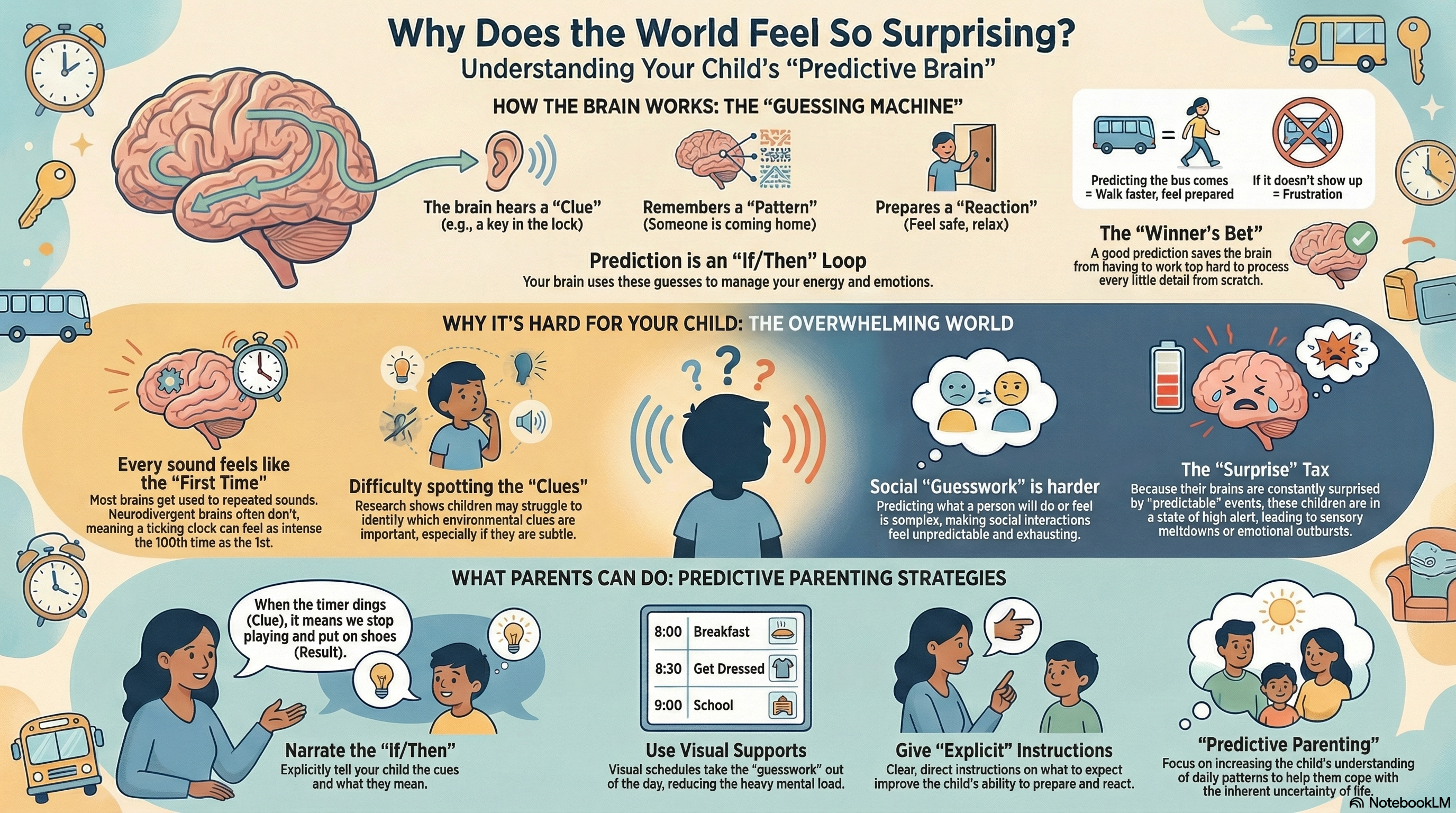
Researchers looked at 47 different studies to understand a core theory: that the autistic brain processes the world by predicting what happens next—or struggling to do so. For many neurotypical people, the brain acts like an experienced navigator, automatically sensing the shift in the currents before the ship even begins to drift. For our autistic children, that internal sensor often works differently, making it harder to link a cause with an effect, especially when the signals are quiet or inconsistent.
This means that things we take for granted—like the fact that a bell ringing means school is over, or that a specific facial expression means someone is joking—can feel unpredictable. The study found that this “predictive processing” difference applies to everything from how a child moves their eyes to how they handle social interactions. When the world feels like a series of surprises rather than a steady passage, the mental effort required just to exist can be exhausting.
Why This Matters for Your Family
If your child struggles with transitions or seems to “overreact” to small changes, this research offers a powerful “why.” When the brain can’t easily predict the next step in a sequence, every transition feels like steering a ship into a sudden, thick fog. Without a clear chart of what’s coming next, the nervous system stays on high alert, waiting for a “jump scare” that might be just around the corner.
This also explains why sensory environments can feel so overwhelming. For many of us, the brain eventually “tunes out” the hum of a refrigerator or the ticking of a clock because it predicts those sounds will continue. For an autistic child, the brain may treat every single sound as a brand-new, high-priority event. As co-parents, understanding this helps us move away from seeing “behavior” and toward seeing a child who is trying to find their footing in waters that feel constantly choppy and loud.
What You Can Do Today
- Increase signal strength with visual anchors. Since the research shows that subtle cues are hard to catch, use high-contrast visual schedules or timers to make the “next step” in your daily voyage impossible to miss.
- Audit the “background noise” in both homes. Look for sensory inputs that aren’t consistent, like a flickering light or an intermittent humming appliance, and work together as co-captains to minimize these unpredictable “jolts” to your child’s system.
- Simplify the predictive load through routine. You don’t need to be perfect, but keeping the “big rocks” of the day (like wake-up times or hand-off rituals) consistent between houses provides a safe harbor where your child’s brain can finally rest from its constant “fortune-telling” work.
The Original Paper
Cannon, J., O’Brien, A. M., Bungert, L., & Sinha, P. (2021). Prediction in Autism Spectrum Disorder: A Systematic Review of Empirical Evidence. Autism Research, 14(4), 604-630.
Safety Note: This research summary is for informational purposes only and does not constitute medical or therapeutic advice. Always consult qualified professionals for your family’s specific situation. If you or your child are in crisis, contact your local emergency services or one of these helplines: 988 Suicide & Crisis Lifeline (US) | Lifeline Australia: 13 11 14 | Samaritans UK: 116 123 | Need to Talk? NZ: 1737
Research Brief
Generated by NotebookLM from the original paper. Not a replacement for the peer-reviewed source.
Read Full Brief →