Enhancing interactions during daily routines: A randomized controlled trial of a web-based tutorial for parents of young children with ASD.
Ibañez Lisa V, Kobak Kenneth, Swanson Amy, Wallace Lisa, Warren Zachary, Stone Wendy L
What This Paper Found
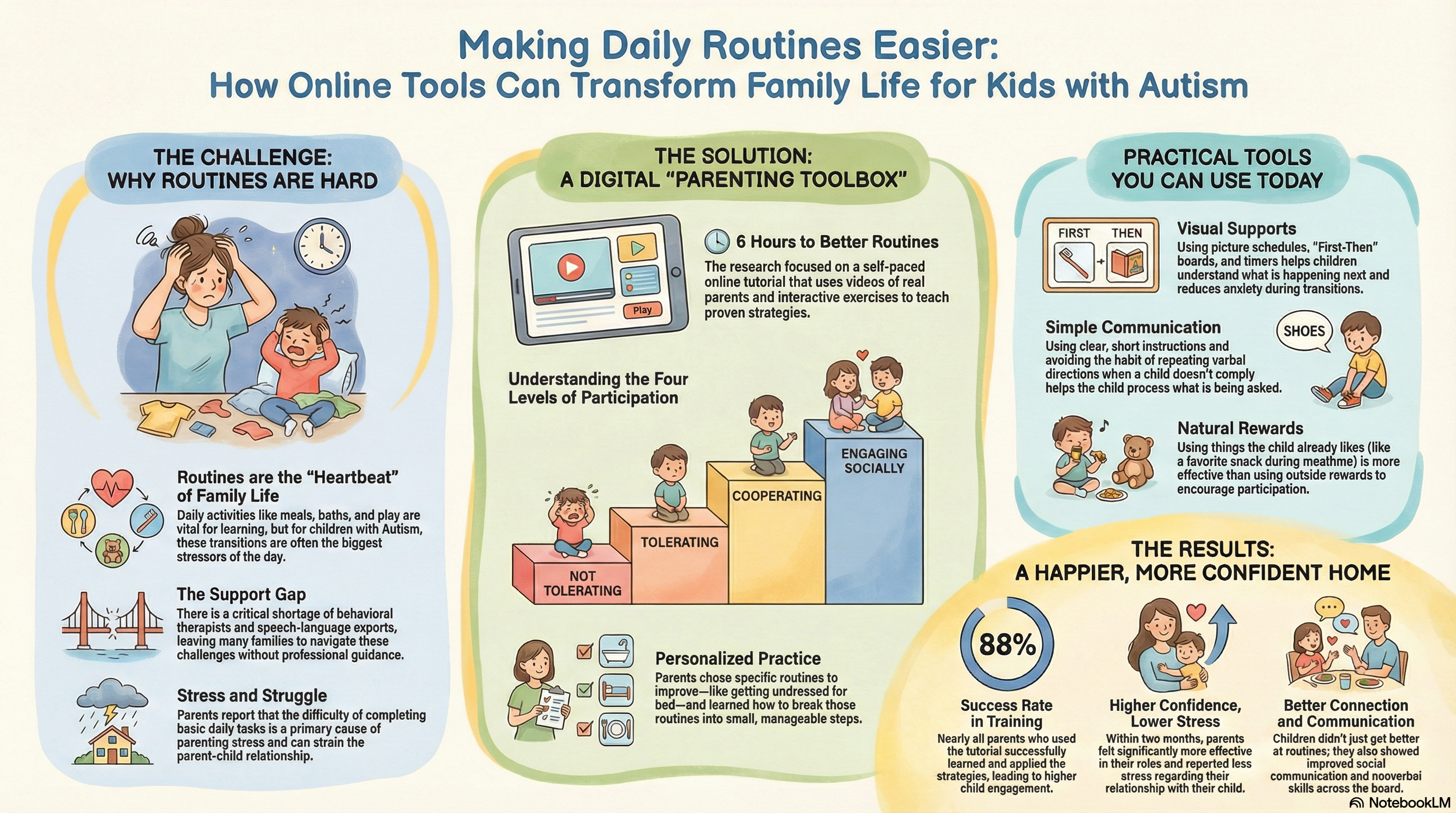
Managing the daily tide of bedtime, bathtime, and meals often feels like navigating a storm without a compass. Researchers recently looked at how a simple, interactive online tutorial could help parents of autistic children navigate these high-pressure moments. They found that parents who used the tutorial were able to use more effective strategies to help their children engage during daily tasks.
The results weren’t just about getting through the routine; they reached much deeper. Children in the study showed improvements in their social communication, and perhaps most importantly, the parents reported feeling significantly less stressed and more confident in their roles. It turns out that having a clear set of strategies helps the “captain” feel more capable and less exhausted by the constant waves of daily demands.
By learning these techniques at home, parents were able to turn ordinary chores into natural opportunities for connection. The study suggests that web-based training is a promising way to get evidence-based tools into the hands of families who might not have easy access to specialists, helping to steady the ship for everyone involved.
Why This Matters for Your Family
We often hear that we need to “work on” communication, but it’s hard to find the time when you’re just trying to keep the ship afloat. This research reminds us that we don’t necessarily need to carve out extra time for “therapy” if we can weave supportive strategies into the things we’re already doing—like eating breakfast or getting dressed. When the daily routine becomes more predictable, the entire family’s stress level tends to drop.
For co-parents, this is a significant finding. When both parents have access to the same navigation charts, such as an online tutorial, it reduces the friction of trying to explain why a certain approach works. It allows you to work as a unified crew, making transitions between homes or even just switching between “parent shifts” much smoother. When the plan is shared, the mental load is lightened for both of you.
It also validates the idea that your confidence as a parent is directly tied to having the right tools. Parenting an autistic child often involves a steep learning curve, and it’s okay to seek out structured guidance. Seeing small wins in a morning routine can be the “lighthouse” that helps you find your way through a difficult week, proving that even minor adjustments can lead to a calmer household.
What You Can Do Today
- Turn routines into mini-connection points. Instead of rushing through a task like hand-washing, look for one small way to encourage communication, such as waiting for a glance or a gesture before handing over the towel.
- Explore accessible online resources. You don’t always have to wait for an in-person appointment; look for evidence-based web tutorials or videos that you and your co-parent can watch together from your own harbor.
- Prioritize your own steady helm. Acknowledge that improving a routine is a gift to yourself as much as it is to your child; reducing the chaos of a morning routine is a valid and necessary way to lower your own stress levels.
The Original Paper
Ibañez, L. V., Kobak, K., Swanson, A., Wallace, L., Warren, Z., & Stone, W. L. (2018). Enhancing interactions during daily routines: A randomized controlled trial of a web-based tutorial for parents of young children with ASD. Autism Research, 11(4), 667-678.
Safety Note: This research summary is for informational purposes only and does not constitute medical or therapeutic advice. Always consult qualified professionals for your family’s specific situation. If you or your child are in crisis, contact your local emergency services or one of these helplines: 988 Suicide & Crisis Lifeline (US) | Lifeline Australia: 13 11 14 | Samaritans UK: 116 123 | Need to Talk? NZ: 1737
Research Brief
Generated by NotebookLM from the original paper. Not a replacement for the peer-reviewed source.
Read Full Brief →