Rate and predictors of divorce among parents of youths with ADHD.
Wymbs Brian T, Pelham William E, Molina Brooke S G, Gnagy Elizabeth M, Wilson Tracey K, Greenhouse Joel B
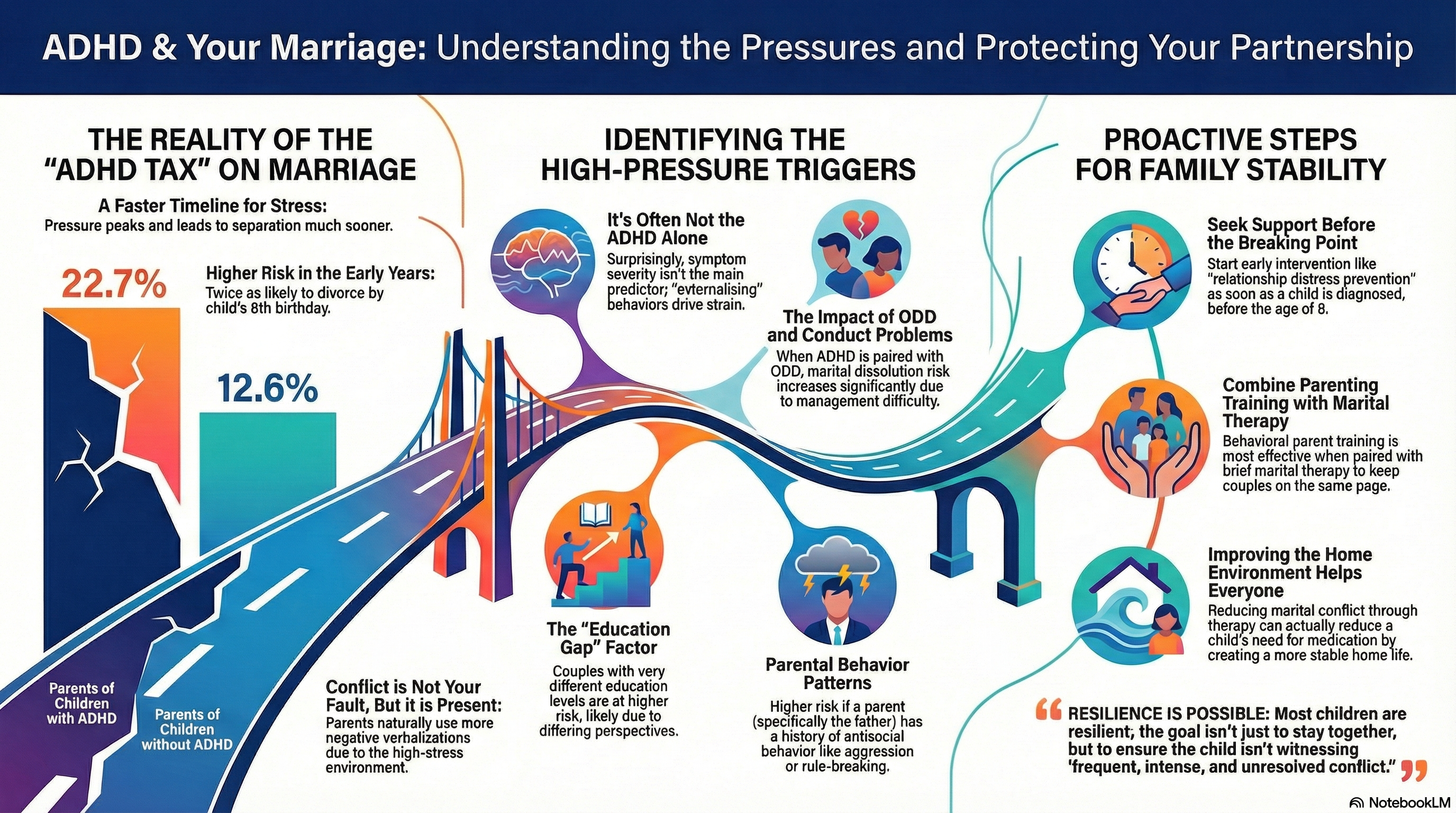
What This Paper Found
Researchers compared hundreds of families to see how the presence of ADHD affects the long-term stability of a partnership. They found that parents of children with ADHD do face a higher risk of divorce, and that separation often happens sooner than in families without these diagnoses. This isn’t about a lack of love or effort; it’s a reflection of the intense, sustained pressure that comes with navigating these uncharted waters.
The study also highlighted that the risk isn’t uniform. When a child also struggles with oppositional or defiant behaviors (ODD), the strain on the deck can feel even more precarious. The researchers noted that it’s often a combination of factors—including the parents’ own backgrounds and the child’s specific needs—that creates a “perfect storm” for marital conflict. Knowing this isn’t meant to be discouraging; it’s meant to validate why things might feel so much harder for you than for the neighbors.
Why This Matters for Your Family
If you’ve felt like you and your co-captain are constantly bickering over routines or discipline, this research confirms that you aren’t imagining the extra weight on your shoulders. Parenting a neurodivergent child requires a level of coordination and emotional labor that most standard parenting manuals simply don’t prepare you for. When the “voyage” involves constant advocacy, sensory management, and behavioral support, the relationship between parents can easily be relegated to the background.
Recognizing that marital conflict is often a side effect of parenting stress—rather than a fundamental flaw in your partnership—can be incredibly freeing. It allows you to stop blaming each other for the choppy seas and start looking at the environment you’re sailing in. When we understand that the external pressure is what’s causing the friction, we can stop fighting each other and start working together to shore up the hull.
What You Can Do Today
- Externalize the conflict. When tension rises, try to label it as “the ADHD stress” or “the ODD burnout” rather than a personal failing of your partner. Remind yourselves that you are on the same boat, even when you disagree on which sail to pull during a crisis.
- Schedule “Maintenance” huddles. Set aside ten minutes once a week—not for logistics or venting, but to check in on how you are functioning as a team. This keeps communication lines open before a small leak becomes a flood.
- Seek neuro-affirming support early. Standard marriage counseling sometimes misses the nuances of neurodivergent family life. Look for professionals who “get” ADHD and PDA so you receive strategies that actually work for your specific family map.
The Original Paper
Wymbs, B. T., et al. (2008). Rate and predictors of divorce among parents of youths with ADHD. Journal of Consulting and Clinical Psychology.
Safety Note: This research summary is for informational purposes only and does not constitute medical or therapeutic advice. Always consult qualified professionals for your family’s specific situation. If you or your child are in crisis, contact your local emergency services or one of these helplines: 988 Suicide & Crisis Lifeline (US) | Lifeline Australia: 13 11 14 | Samaritans UK: 116 123 | Need to Talk? NZ: 1737
Research Brief
Generated by NotebookLM from the original paper. Not a replacement for the peer-reviewed source.
Read Full Brief →