The Caring Compass - Self Care For Co Parents
Preview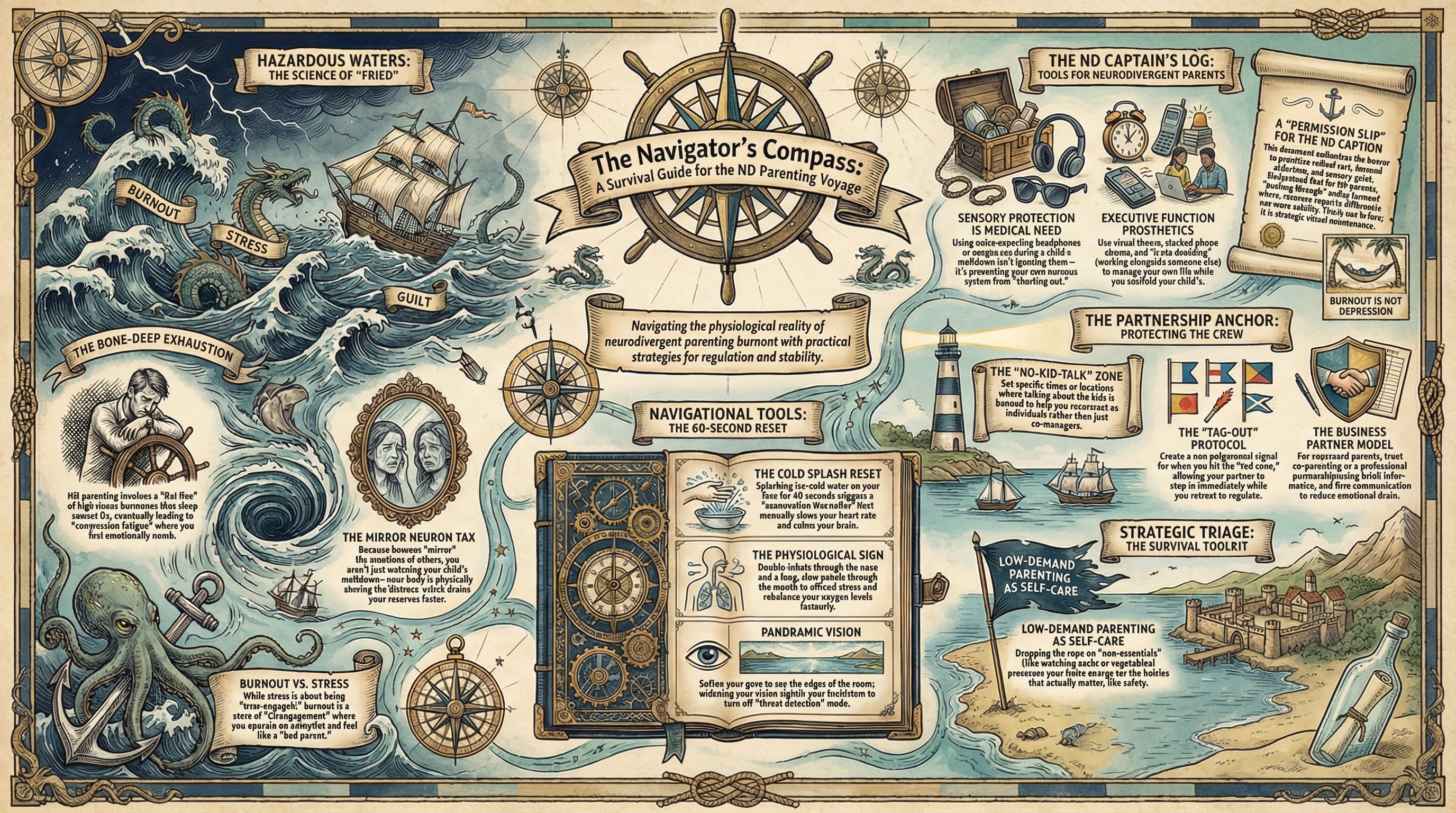

Quick Map: If you only read one page, read this
- The Oxygen Mask: Self-care is a physiological requirement for co-regulation. A dysregulated parent will struggle to calm a dysregulated child.
- Allostatic Load: ND parenting creates chronic "high-alert" stress that damages the body over time. Validating this exhaustion is the first step to recovery.
- Empathy Fatigue: "Mirror neuron tax" means you physiologically share your child's distress. Numbness is a safety mechanism, not a lack of love.
- Micro-Habits: Use vagus nerve "hacks" like the cold splash or physiological sigh to reset your nervous system in under 60 seconds.
- The Partnership Anchor: Protect your relationship by creating "No-Kid-Talk" zones and using structured "State of the Union" agendas.
Field Guide: The Science of Burnout
What's happening in the brain/body: Parenting a neurodivergent child involves Allostatic Load—the cumulative wear and tear on the body from chronic stress. Unlike "normal" stress (which spikes and recovers), this is a "flat line" of high cortisol. Your brain's threat detection system (amygdala) gets stuck in the "on" position, scanning for the next meltdown. This leads to Compassion Fatigue: the physical inability to care because your empathy circuits are fried.
What it looks like at home: You aren't just "tired." You feel a bone-deep exhaustion that sleep doesn't fix. You might feel "touched out" (skin feels like it's burning if someone hugs you) or emotionally numb ("I see my child crying and I feel nothing"). You might fantasise about driving past your exit and never coming back. If you are having thoughts of harming yourself or leaving unsafely, reach out to local crisis support; in Aotearoa New Zealand call 111 in an emergency or use Lifeline Aotearoa (0800 543 354), Need to Talk? (1737), Youthline (0800 376 633), or Whakarongorau Aotearoa Healthline (0800 611 116). This isn't a lack of love; it's a neurological safety shutdown.
What helps:
- Completing the Stress Cycle: Sleep doesn't remove stress hormones; physical activity does. Shaking, dancing, crying, or a 20-second hug signals "safe" to your body.
- Micro-Rest: You don't have time for a spa day. You do have time for a "physiological sigh" (see Toolkit) while waiting for the kettle.
- Radical Lowering of Standards: "Good enough" is the goal. Frozen pizza is fine. Screen time is a tool, not a failure.
What backfires:
- Numbing: Scrolling social media for 2 hours feels like rest, but it keeps the brain stimulated.
- Comparisons: Looking at "Instagram mums" spikes shame (cortisol).
- Waiting for a "Break": The break isn't coming. You have to steal rest in 5-minute increments.
One sentence to remember: "Burnout is not a character flaw; it is a physiological response to an unsustainable load."
Introduction: The Physiological Imperative of the Oxygen Mask
In the lexicon of therapeutic advice offered to caregivers, few metaphors are as pervasive—or as frequently dismissed—as the safety instruction from commercial aviation: “Put your own oxygen mask on before assisting others.” For co-parents navigating the complex, often turbulent waters of raising neurodivergent children, this directive frequently registers not as wisdom, but as an operational impossibility. When a child is in the throes of a sensory meltdown, experiencing an acute dopamine deficit, or navigating the rigid anxiety of a demand-avoidant episode, the parental instinct is biological and absolute: suspend one’s own needs to stabilise the vulnerable offspring.
However, the scientific literature on caregiver well-being suggests that this self-sacrificial instinct, while evolutionarily understandable, is fundamentally maladaptive in the context of chronic neurodevelopmental care. The parent in this dynamic is not merely a passenger offering temporary assistance; they are the vessel itself—the structural frame of the voyage, the drive that powers forward momentum, and the compass that determines the trajectory of the family unit. If the vessel succumbs to the pressure of relentless stress, the entire voyage is compromised.
This chapter is a cartographic guide to recalibrating the parental compass from unsustainable self-sacrifice to strategic self-preservation. This shift is not a concession to selfishness but a physiological requirement for effective co-regulation. The data concerning this demographic is sobering: parents of children with Autism Spectrum Disorder (ASD) and Attention Deficit Hyperactivity Disorder (ADHD) report significantly higher levels of parenting stress, anxiety, and depression compared to parents of neurotypical children.¹ This disparity is not merely a result of logistical burden but stems from the unique, pervasive, and often invisible demands of managing neurodivergent profiles that include Pathological Demand Avoidance (PDA) and Oppositional Defiant Disorder (ODD).
Continue Reading
Unlock the full content including Tactical Strategies, Parent Toolkit, and Survival Card.
Get Full AccessPay what you can - from $5