The Voyage Continues - A Neurodivergent Co Parents Manifesto
Preview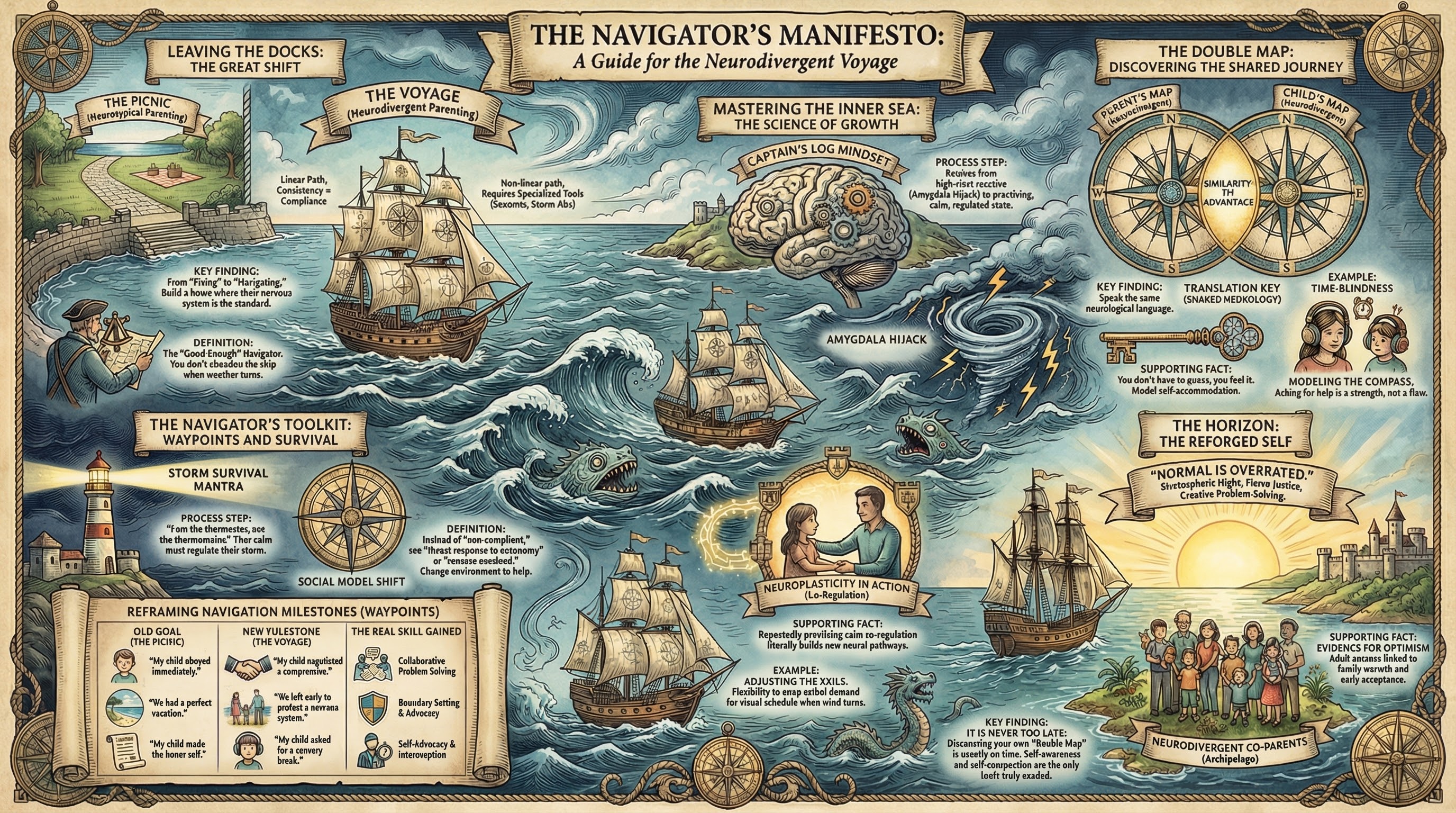

Quick Map: If you only read one page, read this
- The Transformation: You started as a confused tourist; you are ending as a seasoned cartographer.
- The Nonlinear Course: Progress isn't a straight line. It's a spiral. Revisit old landmarks with new skills.
- The "Good Enough" Guide: You don't need to be perfect. You just need to stay on the course.
- The Community: You are now part of the "Neurodivergent Co-Parent" archipelago. You are not alone.
- The Legacy: Your greatest achievement isn't "fixing" your child; it's teaching her to navigate her own waters.
Field Guide: The Science of Parental Resilience and Post-Traumatic Growth
What's happening in the brain/body: Chronic stress from raising a neurodivergent child doesn't just damage—it can also transform. Research on Post-Traumatic Growth (PTG) shows that navigating sustained adversity can trigger positive psychological changes: increased personal strength, deeper relationships, greater appreciation for life, and new possibilities. Neurologically, this occurs through neuroplasticity—your brain has literally rewired itself over the years of co-regulation. Initially, your nervous system lived in "high-alert" (sympathetic) mode. Over time, as you mastered co-regulation, you strengthened the neural pathways between your prefrontal cortex and amygdala, moving from reactive "amygdala hijacks" to a practiced, calm "Captain's Log" mindset. These are permanent neural architecture changes. Your child's brain is also evolving; repeated experiences of safe, co-regulated transitions build the white matter tracts necessary for their future independence.
What it looks like at home: The "storms" (meltdowns, sensory shutdowns) still occur, but the household recovery time is dramatically faster than it was years ago. You can now predict meltdown triggers before they happen, reading your child's subtle cues. You no longer take a PDA refusal as a personal mutiny; you see it as a "threat to safety" in the child's brain and adjust the sails. You and your co-parent may still disagree, but you now have a shared lexicon (dopamine, executive function, sensory load) that allows you to resolve conflicts without sinking the ship. Challenges that paralyzed you 3 years ago (IEP meetings, public meltdowns) now feel manageable. You catch yourself coaching other parents through similar struggles. Most tellingly, you can look back at the "before" version of yourself and barely recognize that panicked, isolated person. You've become a different navigator.
What helps:
- Intentional reflection: Actively reviewing your growth ("I used to yell; now I co-regulate") solidifies the neural pathways of resilience and builds parental self-efficacy
- Meaning-making: Finding purpose in the struggle ("This taught me patience/empathy/advocacy") activates the brain's reward circuits, counteracting stress
- Community identity: Identifying as a "Neurodivergent Co-Parent" (vs. "struggling parent") shifts from victim narrative to expert narrative; connecting with other ND co-parents reduces the "mirror neuron tax" of isolation
- Celebrating micro-victories: Documenting small wins trains your brain to scan for progress instead of only problems (counteracts negativity bias)
- The "Good Enough" Standard: Recognizing that perfection is the enemy of navigation
- Humor as regulation: Laughing at the chaos releases endorphins and signals your nervous system that you're safe despite the stressors
What backfires:
- The "Cure" Narrative: Trying to fix the neurology rather than the environment leads to burnout
- Toxic positivity: Forcing yourself to be grateful for the struggle while suppressing legitimate grief (creates emotional suppression, not growth)
- Forecasting: Predicting a catastrophic future for your teen based on a bad Tuesday
- Comparing timelines: "I should be over this by now"—resilience isn't linear; it's a spiral with setbacks
- The Comparison Anchor: Comparing your spiky-profile child to a neurotypical neighbor's "linear" child
- Perfectionism: Believing you must never have hard days again now that you're "experienced"—resilience means bouncing back faster, not never falling
One sentence to remember: "You are not the same person who started this voyage—you have been forged into a specialized navigator, and that transformation is your superpower."
1. Introduction: The Return of the Cartographers
The narrative arc of raising a neurodivergent child—whether that child presents with Attention Deficit Hyperactivity Disorder (ADHD), Autism Spectrum Disorder (ASD), Pathological Demand Avoidance (PDA), or Oppositional Defiant Disorder (ODD)—is rarely a straight line. It is a nautical chart full of unexpected swells, sudden calms, and uncharted waters. This final chapter, titled "The Voyage Continues," serves as both a conclusion to the comprehensive guide and a manifesto for the future. It revisits the foundational metaphors established at the book’s inception, specifically the transition from a "picnic" mindset to a "long-range voyage" reality, and synthesizes the scientific, emotional, and practical strategies co-parents have acquired.
The voyage of the neurodivergent co-parent is one of transformation. At the outset, many parents find themselves standing on the dock of a passage they did not consciously choose. They clutch a map that does not match the sea beneath their feet.
This initial disorientation marks the moment a parent realizes they packed for a gentle day-sail only to find themselves in the ice-choked Southern Ocean. They now require sextants, storm jibs, and specialized expertise.
Continue Reading
Unlock the full content including Tactical Strategies, Parent Toolkit, and Survival Card.
Get Full AccessPay what you can - from $5