The Wider Village - Family Friends And Finding Support
Preview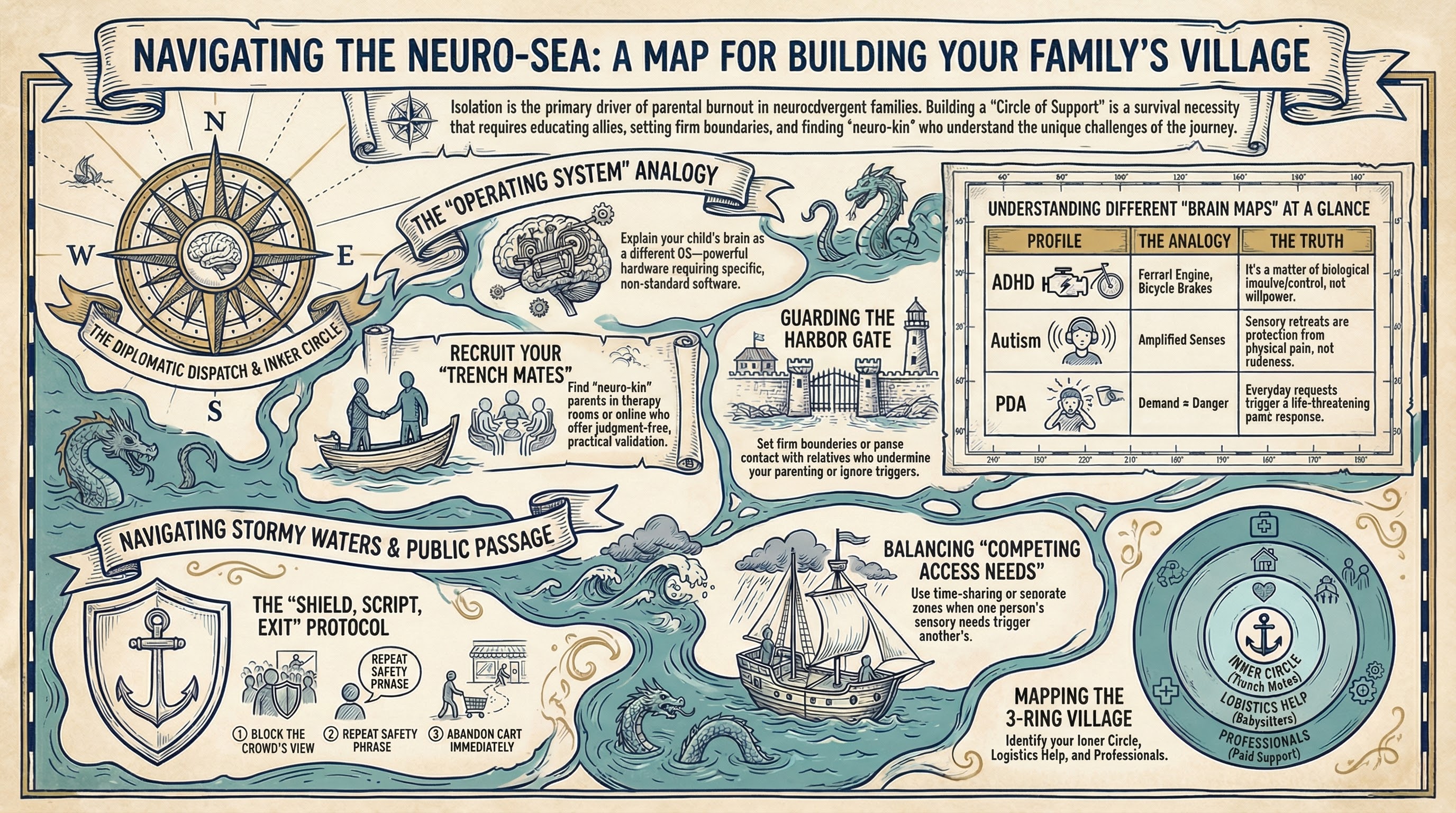

Quick Map: If you only read one page, read this
- The Whānau Imperative: Isolation is the primary driver of burnout. Building your whānau—your village of support—is a survival necessity, not a luxury.
- The Diplomatic Corps: Use the "Operating System" analogy to explain your child's brain to sceptical extended family.
- Guarding the Harbour: Protect the core family unit by setting firm boundaries with relatives who undermine your parenting strategies.
- Neuro-Kin: Seek out other ND parents ("Trench Mates") for validation and practical, judgement-free advice.
- The Public Square: Navigate supermarket meltdowns using the "Shield, Script, Exit" protocol. Your focus is the child, not the audience.
Field Guide: The Science of Social Support
What's happening in the brain/body: Isolation triggers a biological stress response. Research shows parents of neurodivergent children experience significantly higher stress and anxiety than those with neurotypical kids, but social support acts as a powerful buffer against depression and burnout. When you're chronically isolated, your cortisol stays elevated, your immune system weakens, and your capacity for emotional regulation tanks. The neurodivergent parenting voyage is a marathon requiring a crew—other parents who understand the specific language of sensory meltdowns, support battles, and medication titration. Without this whānau—this village—the risk of caregiver burnout and family system collapse skyrockets.
What it looks like at home: You avoid playdates because explaining your child's needs feels exhausting. You stop going to family gatherings because Grandma makes passive-aggressive comments about "discipline." You feel like the only parent in the world dealing with a child who screams for 2 hours over sock seams. You're touch-starved from co-regulation but have no one to co-regulate you. The loneliness becomes a physical ache.
What helps:
- Find "neuro-kin" (other ND parents) in groups, therapy waiting rooms, or school PTA/whānau support groups
- Educate extended family using the "Operating System" analogy
- Create boundaries with toxic relatives who undermine your strategies
- Build a "Respite Ranger" (trusted person who can handle a meltdown)
- Map your whānau (identify who's in Ring 1 "trench mates" vs Ring 2 "logistics help" vs Ring 3 "professionals")
What backfires:
- Isolating yourself because "no one gets it" (creates burnout spiral)
- Oversharing about your ex in public ND parent groups (can backfire legally)
- Forcing family relationships that harm your child's regulation
- Comparing your voyage to neurotypical parents
- Hiding at home to avoid public meltdowns (robs child of community access)
One sentence to remember: "The whānau isn't found—it's built, one boundary and one honest conversation at a time."
Introduction: The Cartography of Connection in a Neurodivergent World
When you first received the map of your child's neurodivergence—marked with the complex seascape of ASD, the rapid currents of ADHD, the intricate winds of PDA, or the steep reefs of ODD—you likely felt like a lone navigator stranded on an uncharted island. The early days are frequently defined by a necessary, protective insularity. The nuclear family turns inward, reinforcing the harbour to weather the initial storms. In this phase, you become the sole cartographers of this new world.
But no island can sustain itself forever. In Māori culture, whānau extends beyond the nuclear family to include grandparents, aunties, uncles, and all those who contribute to a child's wellbeing. This concept—that raising children is a collective responsibility—aligns perfectly with co-parenting: it truly does take a village, a whānau, to raise a neurodivergent child. Yet for many families, this whānau often feels more like a restricted port we are trying to enter, or worse, a tribunal passing judgement on our parenting methods.
The village effectively disappears when she screams in a supermarket because the lights are humming, or when a cousin is shoved due to her impulsive excitement. The isolation that follows is structurally and psychologically unsustainable.
Continue Reading
Unlock the full content including Tactical Strategies, Parent Toolkit, and Survival Card.
Get Full AccessPay what you can - from $5